January 26, 2026 – Federal Oversight Report
LOVED ONES COALITION
Weekly Oversight Report
Documenting Systemic Violations Across the Federal Bureau of Prisons
January 26, 2026
This Weekly Oversight Report follows the January 5 and January 12, 2026 reports issued by Loved Ones Coalition documenting urgent, systemic failures across multiple Bureau of Prisons facilities. Due to the volume, severity, and corroboration of the information received during that reporting period, these findings were escalated directly to senior Bureau leadership.
Deputy Director Joshua Smith was made aware of the documented conditions and, to his credit, responsive action followed. Within days, multiple facilities experienced visible leadership engagement, increased staff presence, and short-term corrective measures. Conditions that had persisted for months or years were acknowledged only after senior leadership intervention.
That response mattered. It demonstrated that when leadership intervenes, the Bureau is capable of immediate corrective action.
However, this reporting period documents what occurred after that initial intervention — once attention shifted and direct oversight eased.
At several facilities, including FCI McKean, staff quickly reverted to punitive control measures. In McKean specifically, staff imposed collective punishment on an entire housing range, restricting movement and privileges after identifying a pretextual incident. This action occurred shortly after individuals reported conditions and after assurances were made that reporting would not result in retaliation. Rather than addressing individual conduct, the response penalized an entire population.
Similar patterns emerged elsewhere:
- Explicit warnings issued discouraging further reporting
- Staff referencing Loved Ones Coalition by name while suppressing complaints
- Temporary remediation followed by renewed intimidation and restriction
- Retaliatory enforcement framed as “discipline” or “security”
These actions are not isolated. They reflect a consistent institutional response: exposure prompts brief correction; correction is followed by collective punishment, intimidation, or suppression; and conditions regress once oversight pressure subsides.
This sequence demonstrates a systemic failure of sustained accountability. Compliance appears reactive rather than operational, and improvements are contingent on escalation rather than embedded policy adherence.
This report documents not only conditions of confinement, but the retaliatory response cycle that follows exposure — a cycle that undermines lawful reporting, discourages whistleblowers, and places incarcerated individuals and staff at continued risk.
Loved Ones Coalition submits this report to place the Bureau of Prisons, the Department of Justice, and Congressional oversight bodies on notice that without structural protections against retaliation and collective punishment, corrective action will remain temporary and violations will persist.
MID-ATLANTIC REGION
FCC Hazelton (West Virginia)

1. SUMMARY OF ALLEGATIONS
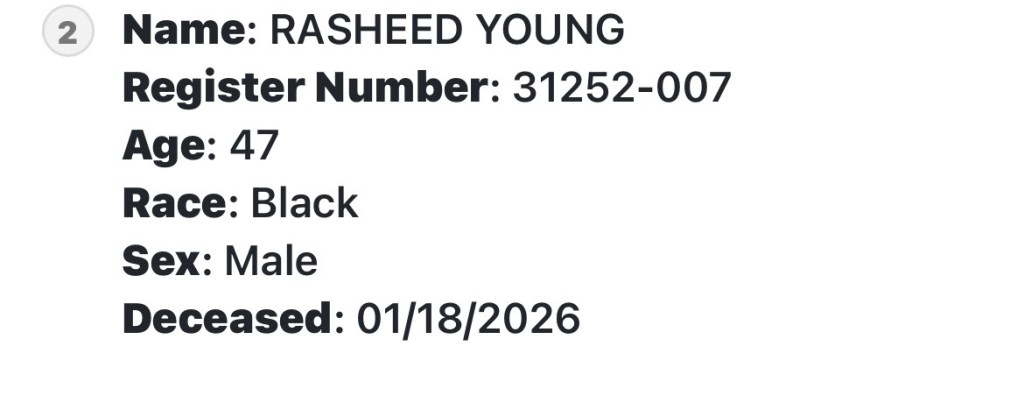
Loved Ones Coalition received multiple, corroborating eyewitness accounts concerning the death in custody of Rasheed Young, Register Number 31252-007, age 47, who died on January 18, 2026, while incarcerated at USP Hazelton, a component facility of FCC Hazelton. Mr. Young was reportedly housed in A2 Unit and had recently undergone a custody status change shortly before his death.
According to testimony provided by incarcerated witnesses who were physically present during the incident, Mr. Young experienced progressive and escalating medical distress over a period of several days prior to January 18. Witnesses report that he repeatedly sought medical assistance for breathing-related symptoms and other distress, yet was consistently returned to his housing unit without diagnostic evaluation, escalation of care, or emergency intervention.
On January 18, Mr. Young reportedly activated his distress button and exited his cell exhibiting acute respiratory distress, visible panic, and an inability to breathe. Multiple inmates immediately responded, escorting him to the officers’ area while repeatedly calling out for medical assistance. Witnesses state that Mr. Young demonstrated clear signs of a medical emergency, including gasping for air and physical gestures indicating respiratory failure.
Despite the severity of his condition and the visible urgency of the situation, witnesses report a delay in effective medical response. Fellow inmates retrieved Mr. Young’s asthma inhaler and attempted to assist him in administering it, noting that Mr. Young had limited motor function on his left side due to a prior stroke, impairing his ability to self-administer medication. Correctional officers eventually contacted medical staff, though witnesses remain uncertain whether the gravity of the emergency was accurately communicated.
Mr. Young was later removed from the unit on a stretcher and transported out of sight. Incarcerated individuals were subsequently informed that he had died. Witnesses further report concerns regarding extensive prescription medication possession, raising questions about medication management, monitoring, contraindications, and continuity of care.
Taken together, the testimony reflects a pattern of dismissed medical complaints, delayed emergency response, and potential failure to provide constitutionally adequate medical care, culminating in a preventable death.
2. KEY ALLEGATION & VIOLATION TABLE
| Allegation | Policy / Statute Violated |
| Repeated dismissal of medical complaints in days preceding death | BOP Program Statement 6031.04 (Patient Care) |
| Failure to identify and escalate a medical emergency | BOP Program Statement 6000.05 (Health Services Administration) |
| Delayed response to respiratory distress and panic symptoms | 28 C.F.R. § 549.70 |
| Inadequate emergency medical response procedures | BOP Program Statement 5566.06 |
| Failure to accommodate known medical vulnerabilities (prior stroke) | Rehabilitation Act of 1973, Section 504 |
| Deliberate indifference to serious medical needs | Eighth Amendment, U.S. Constitution |
3. DIRECT TESTIMONY / DIRECT QUOTES
- “He had been going to medical damn near the whole week for similar symptoms, but they always sent him away.”
- “He came busting out of his cell after pressing his distress button.”
- “Young kept waving his hands to show that he couldn’t breathe.”
- “Someone ran and grabbed his asthma inhaler because he couldn’t use his left side.”
- “We were yelling for officers and medical help.”
- “They eventually came in with the stretcher and took him out.”
- “All we know is that he later died.”
4. SYSTEMIC CONCERNS
- Apparent normalization of returning medically distressed individuals to housing units without diagnostic escalation.
- Failure to treat respiratory distress as a time-sensitive medical emergency.
- Lack of accommodation for inmates with known neurological impairments affecting self-care.
- Serious questions regarding prescription medication oversight, monitoring, and potential contraindications.
- Concerns that Mr. Young’s medical profile warranted designation to a Federal Medical Center, not a high-security penitentiary.
5. OVERSIGHT DEMANDS — FCC HAZELTON (MID-ATLANTIC REGION)
- Provide written confirmation of Mr. Young’s identity, official cause of death, and exact time of death.
- Preserve and produce all medical records, medication administration logs, sick call requests, and clinical assessments from the two weeks preceding January 18, 2026.
- Preserve and produce all incident reports, staff duty logs, radio traffic, emergency response records, and relevant video footage from A2 Unit and surrounding areas.
- Confirm whether the death has been referred to the Department of Justice Office of the Inspector General and identify the referral date.
- Identify all medical and custody staff involved in responding to Mr. Young’s medical complaints in the days prior to his death.
- Provide written clarification of USP Hazelton’s emergency response protocols for respiratory distress and how those protocols were applied in this case.
- Conduct an immediate review of medical designation procedures to determine whether Mr. Young should have been housed at a Federal Medical Center.
6. CONCLUSION
The death of Rasheed Young at FCC Hazelton following repeated, documented medical complaints and visible respiratory distress presents serious indicators of systemic medical failure. Loved Ones Coalition places the Bureau of Prisons on notice that this death will remain under active oversight pending full evidence preservation, transparent investigation, and independent review of staff actions and institutional medical practices.
MID-ATLANTIC REGION
FCI Alderson (West Virginia)
1. SUMMARY OF ALLEGATIONS
Loved Ones Coalition received testimony from an elderly family member of an incarcerated woman newly designated to FCI Alderson, alleging that institutional staff failed to assist her in obtaining essential information required to fund inmate telephone calls. The family member reported that during her daughter’s first outbound call, an automated operator message provided a phone number necessary to place funds on the inmate’s phone account. Due to her advanced age and physical disabilities, she was unable to record the information before the message ended. When she subsequently contacted the institution directly seeking assistance, staff were unable or unwilling to provide the information, stating they did not know the phone number and offering no guidance on how to proceed. This allegation reflects a failure of staff support, accessibility, and basic family communication assistance, disproportionately impacting elderly and disabled individuals.
2. KEY ALLEGATION & VIOLATION TABLE
| Allegation | Policy / Statute Violated |
| Failure of staff to assist a family member seeking required inmate telephone service information | BOP Program Statement 5264.08 (Inmate Telephone Regulations) |
| Refusal or inability to provide basic guidance to an elderly, disabled individual | Rehabilitation Act of 1973, Section 504 |
| Inadequate staff knowledge of standard communication services | BOP Program Statement 4500.12 (Trust Fund/Deposit Fund Manual) |
| Obstruction of reasonable family communication access | 28 C.F.R. § 540.100 |
3. DIRECT TESTIMONY / DIRECT QUOTES
- “I am 73 and have a lot of physical disabilities. By the time I got pencil and paper to write the phone number down it was over.”
- “I tried calling the warden number and the person who answered said they do not know the phone number.”
- “If someone knows that phone number so I can put money on so she can make calls out.”
- “I really appreciate the help.”
4. SYSTEMIC CONCERNS
- Failure of staff to provide assistance to an elderly and disabled family member actively seeking help.
- Lack of staff preparedness to support lawful family communication.
- Overreliance on automated messages without accessible alternatives or staff support.
5. OVERSIGHT DEMANDS — FCI ALDERSON (MID-ATLANTIC REGION)
- Require all institutional phone operators, front-line staff, and administrative personnel to provide accurate guidance on inmate telephone funding procedures upon request.
- Implement clear, written, and publicly accessible instructions for inmate phone services, including accommodation for elderly and disabled family members.
- Establish reasonable accommodation protocols for individuals with disabilities seeking communication assistance, in compliance with Section 504 of the Rehabilitation Act.
- Conduct mandatory staff retraining on family communication obligations and inmate contact policies.
6. CONCLUSION
FCI Alderson’s failure to assist an elderly, disabled family member seeking basic communication information constitutes an avoidable barrier to lawful family contact. Loved Ones Coalition places the Bureau of Prisons on notice that continued staff inaction or refusal to provide assistance will be documented as systemic noncompliance with federal policy and accessibility requirements.
MID-ATLANTIC REGION
USP McCreary (Kentucky)
1. SUMMARY OF ALLEGATIONS
Loved Ones Coalition has received information raising serious concerns regarding systemic failures in medical and mental health care delivery at USP McCreary, including irregular administration of prescribed medications, missed specialty appointments, and lack of accommodation for documented physical disabilities. The information indicates patterns consistent with chronic treatment disruption, rather than isolated error.
Reports describe incarcerated individuals with complex, high-risk medical and psychiatric needs experiencing prolonged lapses in essential care, including insulin-dependent diabetes management, prescribed psychotropic medications, and assistive medical devices. In multiple instances, individuals reportedly went weeks or longer without medically necessary medications, despite active prescriptions, without documented clinical justification or alternative treatment plans.
Concerns further include missed mental health appointments, even when individuals presented themselves for scheduled care and requested access, as well as failures to provide or replace prescribed orthopedic accommodations such as braces, specialized footwear, and assistive devices required for mobility and injury mitigation.
These allegations reflect broader systemic issues involving medication continuity, appointment tracking, disability accommodation, and fear of retaliation that discourages formal reporting. The cumulative impact of these failures places medically vulnerable individuals at significant risk of physical deterioration, psychological destabilization, and preventable medical emergencies.
2. KEY ALLEGATION & VIOLATION TABLE
| Allegation | Policy / Statute Violated |
| Irregular or missed administration of prescribed insulin and other chronic-care medications | BOP Program Statement 6031.04 (Patient Care) |
| Prolonged interruption of prescribed mental health medications | BOP Program Statement 5310.16 (Treatment and Care of Inmates with Mental Illness) |
| Failure to ensure access to scheduled mental health appointments | 28 C.F.R. § 549.70 |
| Failure to provide prescribed assistive devices and orthopedic accommodations | Rehabilitation Act of 1973, Section 504 |
| Inadequate management of complex medical and psychiatric conditions | BOP Program Statement 6000.05 (Health Services Administration) |
| Deliberate indifference to serious medical needs | Eighth Amendment, U.S. Constitution |
3. DIRECT TESTIMONY / DIRECT QUOTES
- “They don’t give him his insulin shots regularly.”
- “He has been over a month without his mental health medications.”
- “He had a psych appointment scheduled, but they never took him down for it, even when he asked.”
- “He has a drop foot and wears special shoes and a brace, but he hasn’t received them.”
- “There’s fear of retaliation if he speaks up.”
4. SYSTEMIC CONCERNS
- Chronic breakdowns in medication continuity for individuals with life-sustaining and psychiatric prescriptions.
- Failure to track, transport, or honor scheduled medical and mental health appointments.
- Lack of timely provision of prescribed assistive devices for mobility impairments.
- Culture of fear and retaliation that discourages incarcerated individuals from reporting lapses in care.
- Absence of safeguards for individuals with compounded medical, psychiatric, and disability-related needs.
5. OVERSIGHT DEMANDS — USP MCCREARY (MID-ATLANTIC REGION)
- Conduct an immediate audit of medication administration records to identify gaps in insulin, psychiatric, and chronic-care medication delivery.
- Preserve and produce documentation related to missed mental health appointments, including transport logs and appointment scheduling records.
- Review procedures for ensuring continuity of care for insulin-dependent and psychiatrically vulnerable individuals.
- Confirm compliance with disability accommodation requirements, including provision and maintenance of prescribed orthopedic and assistive devices.
- Identify safeguards in place to protect incarcerated individuals from retaliation when reporting medical or mental health concerns.
- Provide written clarification of corrective actions taken to address systemic lapses in medical and mental health services.
6. CONCLUSION
The allegations emerging from USP McCreary reflect patterns of disrupted medical and mental health care that pose serious risks to incarcerated individuals with complex clinical needs. Loved Ones Coalition places the Bureau of Prisons on notice that continued failures to ensure medication continuity, appointment access, and disability accommodations will be documented as systemic noncompliance with constitutional, statutory, and policy obligations.
SOUTHEAST REGION
FCI Edgefield (South Carolina)


1. SUMMARY OF ALLEGATIONS
Loved Ones Coalition has received multiple reports and visual documentation raising serious concerns regarding unsafe, unsanitary, and degrading living conditions at FCI Edgefield. The information indicates persistent environmental health hazards, including visible mold growth, chronic plumbing failures, repeated flooding of bathroom areas, and prolonged lack of reliable hot water.
According to reports, these conditions have persisted for an extended period without effective remediation. Bathrooms reportedly flood repeatedly, toilets malfunction or overflow, and standing water accumulates in shared areas. Witnesses further report that the facility’s hot water boiler has repeatedly failed, resulting in incarcerated individuals being forced to shower with freezing or near-freezing water for days or weeks at a time.
Photographic evidence provided shows visible mold growth on ceilings and structural surfaces, as well as areas closed off due to flooding or maintenance failures. Despite the duration and severity of these conditions, reports indicate that no meaningful corrective action has been taken to resolve the underlying infrastructure problems.
These allegations raise significant concerns regarding exposure to mold, unsanitary wastewater conditions, temperature-related health risks, and systemic indifference to basic human needs, all of which implicate constitutional, statutory, and regulatory obligations.
2. KEY ALLEGATION & VIOLATION TABLE
| Allegation | Policy / Statute Violated |
| Exposure to visible mold and unsanitary environmental conditions | BOP Program Statement 1600.11 (National Occupational Safety and Health Policy) |
| Chronic plumbing failures and flooding in bathroom facilities | BOP Program Statement 4200.04 (Facilities Operations Manual) |
| Prolonged lack of reliable hot water for hygiene | 28 C.F.R. § 551.90 |
| Failure to maintain habitable living conditions | Eighth Amendment – Conditions of Confinement |
| Ongoing exposure to health hazards without remediation | BOP Program Statement 6031.04 (Patient Care) |
3. DIRECT TESTIMONY / DIRECT QUOTES
- “Been here over a year and still ain’t done nothing to fix it.”
- “Bathrooms keep flooding and toilets keep messing up.”
- “Hot water boiler keeps breaking, leaving us showering with freezing water for days and weeks at a time.”
- “They want us to die to all this mold.”
4. SYSTEMIC CONCERNS
- Long-term exposure to mold and moisture without environmental remediation.
- Repeated infrastructure failures indicating deferred maintenance rather than isolated incidents.
- Unsanitary bathroom conditions increasing risk of infection and illness.
- Lack of timely response to conditions that pose clear health and safety risks.
- Normalization of substandard living conditions inconsistent with constitutional confinement standards.
5. OVERSIGHT DEMANDS — FCI EDGEFIELD (SOUTHEAST REGION)
- Conduct and document a comprehensive environmental health inspection addressing mold, moisture, and air quality within affected housing units.
- Preserve and produce maintenance records, work orders, and inspection reports related to plumbing, flooding, and boiler failures over the past twelve months.
- Provide written confirmation of corrective actions taken to restore reliable hot water and functional sanitation facilities.
- Identify timelines for permanent remediation of mold-affected areas, including professional abatement where required.
- Confirm interim measures implemented to protect incarcerated individuals from continued exposure to unsanitary or hazardous conditions.
6. CONCLUSION
The conditions reported at FCI Edgefield reflect systemic infrastructure neglect that threatens the health and safety of incarcerated individuals. Loved Ones Coalition places the Bureau of Prisons on notice that continued exposure to mold, unsanitary facilities, and prolonged lack of hot water constitutes an ongoing conditions-of-confinement failure subject to continued oversight and escalation.
SOUTHEAST REGION
FCI Estill (South Carolina)
1. SUMMARY OF ALLEGATIONS
Loved Ones Coalition has received sustained reports regarding systemic conditions-of-confinement failures and administrative practices at FCI Estill following its reopening in 2025 as a women’s camp. Information collected since reopening reflects persistent deprivation of basic necessities, uneven access to programming, and administrative decisions that appear to exacerbate instability rather than promote safety or rehabilitation.
Reports indicate that women housed in the currently occupied unit have experienced repeated shortages of essential hygiene supplies, including toilet paper, prolonged disruptions to commissary access, and irregular meal scheduling. At the time of reporting, incarcerated women allegedly lacked toilet paper, had no available commissary items, and received their evening meal unusually early in the afternoon, leaving extended periods without food access.
In parallel, reports describe significant disparities in conditions between housing units, driven by administrative plans to open an additional housing unit with substantially enhanced amenities. According to multiple accounts, the newly prepared unit includes freshly renovated living space, upgraded flooring, personal-use appliances such as microwaves and refrigerators, and expanded programming availability — amenities not provided to individuals currently housed in the original unit.
Further reports indicate that selection for transfer into the new unit will be administratively determined, with criteria not clearly articulated, while individuals remaining in the original unit experience reduced programming access and curtailed religious services. These differential conditions have reportedly generated heightened stress, tension, and instability among the population.
Additional concerns include reports of questionable medical decision-making, including attempts to prescribe medication-assisted treatment drugs to individuals without documented substance use disorder histories, and failures to provide appropriate, less invasive pain management alternatives. Collectively, these allegations raise serious questions regarding equity, safety, medical ethics, and institutional judgment.
2. KEY ALLEGATION & VIOLATION TABLE
| Allegation | Policy / Statute Violated |
| Deprivation of basic hygiene supplies (toilet paper) | BOP Program Statement 4110.04 (Inmate Clothing and Personal Property) |
| Prolonged commissary disruptions and inadequate food access | 28 C.F.R. § 540.14 |
| Unequal access to programming and services based on housing assignment | BOP Program Statement 5322.13 (Inmate Classification and Program Review) |
| Curtailment of religious services | Religious Freedom Restoration Act (RFRA) |
| Administrative practices creating instability and population conflict | BOP Program Statement 5500.14 (Correctional Services Procedures Manual) |
| Questionable medication practices without clear clinical justification | BOP Program Statement 6031.04 (Patient Care) |
| Failure to provide humane and equitable living conditions | Eighth Amendment – Conditions of Confinement |
3. DIRECT TESTIMONY / DIRECT QUOTES
- “No toilet paper again.”
- “No food on commissary and dinner was at 2:45.”
- “Programming stopped in this unit but continues in the new one.”
- “They’re hand-picking who gets moved.”
- “They’re opening a luxury unit while the rest have nothing.”
- “Trying to put women on medications they don’t need instead of treating the actual issue.”
4. SYSTEMIC CONCERNS
- Chronic deprivation of basic hygiene and commissary access.
- Unequal living conditions and programming access creating internal division.
- Administrative decisions that increase tension and destabilization within the population.
- Reduced access to religious services without adequate justification.
- Medical practices that raise ethical and clinical concerns.
- Appearance of preferential treatment inconsistent with equitable correctional standards.
5. OVERSIGHT DEMANDS — FCI ESTILL (SOUTHEAST REGION)
- Provide documentation confirming availability and distribution of basic hygiene supplies across all housing units.
- Preserve and produce commissary inventory records and disruption logs since reopening in 2025.
- Explain criteria and decision-making processes governing housing transfers into newly opened units.
- Provide written justification for disparities in programming and religious service access between units.
- Review and document medical prescribing practices to ensure compliance with clinical standards and informed consent requirements.
- Identify corrective actions taken to mitigate population instability caused by unequal treatment and resource allocation.
6. CONCLUSION
The conditions and administrative practices reported at FCI Estill reflect systemic failures that undermine safety, equity, and humane confinement. Loved Ones Coalition places the Bureau of Prisons on notice that continued deprivation of basic necessities, unequal access to services, and destabilizing administrative actions will remain under active oversight and subject to escalation.
SOUTHEAST REGION
FCI Jesup (Georgia)
1. SUMMARY OF ALLEGATIONS
Loved Ones Coalition has received multiple reports indicating systemic sanitation and medical accommodation failures at the Federal Prison Camp at FCI Jesup. According to the information provided, an elderly incarcerated individual with a severe and ongoing incontinence condition remains housed in general population without appropriate medical intervention, accommodation, or alternative placement.
As a result, fecal contamination reportedly occurs repeatedly throughout shared hallways and common areas within the camp. Reports indicate that other incarcerated individuals are routinely required to clean human waste from living areas, creating ongoing exposure to biohazardous conditions. These circumstances have allegedly persisted despite repeated internal complaints and staff awareness.
The continued presence of untreated incontinence-related contamination in shared living spaces presents a significant public health risk, including exposure to communicable disease, and reflects a failure to implement basic sanitation safeguards or medical accommodations for a medically vulnerable individual.
2. KEY ALLEGATION & VIOLATION TABLE
| Allegation | Policy / Statute Violated |
| Failure to provide medical care or accommodation for severe incontinence | BOP Program Statement 6031.04 (Patient Care) |
| Repeated exposure of incarcerated individuals to human waste | BOP Program Statement 1600.11 (Occupational Safety and Health) |
| Unsanitary living conditions posing disease risk | Eighth Amendment – Conditions of Confinement |
| Failure to implement disability-related accommodations | Rehabilitation Act of 1973, Section 504 |
| Institutional inaction despite known biohazard conditions | Eighth Amendment – Deliberate Indifference Standard |
3. DIRECT TESTIMONY / DIRECT QUOTES
- “There’s an older inmate who has a serious incontinence issue.”
- “The entire unit is consistently having to clean feces up and down the hallways.”
- “This has been complained about to no avail.”
- “I guess they’re just waiting for somebody to get hepatitis or some type of disease.”
4. SYSTEMIC CONCERNS
- Ongoing exposure of incarcerated individuals to biohazardous waste.
- Failure to medically address or accommodate a known, chronic condition.
- Lack of sanitation protocols for repeated contamination events.
- Institutional normalization of unsafe and unsanitary living conditions.
5. OVERSIGHT DEMANDS — FCI JESUP (SOUTHEAST REGION)
- Conduct an immediate medical evaluation to determine appropriate treatment and accommodation for severe incontinence.
- Preserve and produce all sanitation logs, incident reports, and internal complaints related to fecal contamination within the camp.
- Implement immediate biohazard mitigation and sanitation protocols to protect the population.
- Provide written clarification of policies governing medical accommodation and sanitation response for chronic conditions.
- Identify corrective actions taken to prevent continued exposure to human waste in shared living areas.
6. CONCLUSION
The conditions reported at the Federal Prison Camp at FCI Jesup reflect a systemic failure to address sanitation hazards and medically necessary accommodations. Loved Ones Coalition places the Bureau of Prisons on notice that continued exposure to human waste and institutional inaction constitutes an ongoing conditions-of-confinement violation subject to continued oversight.
SOUTHEAST REGION
FCI Montgomery (Alabama)
1. SUMMARY OF ALLEGATIONS
Loved Ones Coalition has received multiple reports indicating systemic deprivation of basic living accommodations, disruption of rehabilitative programming, and the use of disciplinary threats to enforce compliance at FCI Montgomery. Information provided reflects conditions affecting large portions of the camp population, not isolated individuals.
Reports indicate that over 200 incarcerated individuals have been deprived of basic seating furniture, including chairs necessary for daily living, communal activities, and use within personal living areas. According to multiple accounts, seating was removed by administration and has not been restored. Individuals reportedly face disciplinary sanctions if found sitting in unauthorized areas, creating conditions where individuals are forced to stand or sit on floors for extended periods.
Additional reports describe significant delays and mismanagement of RDAP placement, with incarcerated individuals transferred to the facility specifically for program participation remaining on waiting lists for months without clear timelines, despite eligibility and approaching release dates. Accounts describe inconsistent tracking of waiting lists, shifting placement positions, and lack of transparency regarding program access, resulting in loss of sentence-reduction opportunities.
Further concerns include food insecurity and commissary shortages, with reports indicating insufficient food supply, delivery disruptions, and low commissary availability. Information received suggests that food deliveries may have been interrupted due to administrative or payment failures, resulting in reduced food access for the population.
Taken together, these allegations reflect institution-wide administrative failures, including deprivation of basic necessities, disruption of rehabilitative programming, and conditions that may amount to coercive or retaliatory enforcement practices.
2. KEY ALLEGATION & VIOLATION TABLE
| Allegation | Policy / Statute Violated |
| Removal of basic seating necessary for daily living | BOP Program Statement 4200.04 (Facilities Operations Manual) |
| Use of disciplinary threats to enforce deprivation | BOP Program Statement 5270.09 (Inmate Discipline Program) |
| Delayed or obstructed access to RDAP | BOP Program Statement 5330.11 (Psychology Treatment Programs) |
| Failure to provide adequate food and commissary access | 28 C.F.R. § 551.90 |
| Administrative actions causing loss of earned time opportunities | First Step Act |
| Conditions amounting to unnecessary hardship | Eighth Amendment – Conditions of Confinement |
3. DIRECT TESTIMONY / DIRECT QUOTES
- “Over 200 people don’t have any chairs to sit in.”
- “The warden took them and refuses to give them back.”
- “If they catch you sitting anywhere else, they’re giving shots.”
- “People have been waiting months for RDAP with no timeline.”
- “There is very little food there.”
- “The commissary is running low.”
4. SYSTEMIC CONCERNS
- Large-scale deprivation of basic living accommodations across the camp.
- Use of discipline or threat of discipline to enforce unnecessary hardship.
- Program-access failures that directly affect sentence length and reentry outcomes.
- Food and commissary instability posing nutritional and health concerns.
- Lack of transparency and accountability in administrative decision-making.
5. OVERSIGHT DEMANDS — FCI MONTGOMERY (SOUTHEAST REGION)
- Provide documentation explaining the removal of seating furniture and identify the authority authorizing this action.
- Restore adequate seating and basic living accommodations consistent with humane confinement standards.
- Preserve and produce disciplinary records related to enforcement of seating restrictions.
- Provide RDAP waiting list records, eligibility determinations, and placement timelines since mid-2025.
- Produce food delivery records, vendor contracts, and documentation related to recent supply disruptions.
- Identify corrective actions taken to ensure consistent food access and program availability.
6. CONCLUSION
The conditions reported at FCI Montgomery reflect systemic administrative failures that deprive incarcerated individuals of basic necessities, disrupt rehabilitative programming, and undermine lawful sentence-reduction opportunities. Loved Ones Coalition places the Bureau of Prisons on notice that continued deprivation and program obstruction will remain under active oversight pending documented corrective action.
SOUTHEAST REGION
FCI Yazoo City (Mississippi)
1. SUMMARY OF ALLEGATIONS
Loved Ones Coalition has received reports raising concerns regarding systemic failures in case management practices at FCI Yazoo City, including repeated lack of access to assigned staff, delayed or avoided communication, and routine submission of minimum allowable prerelease placement referrals without individualized consideration. The reports specifically identify L.S. Jackson (case management staff) as the staff member repeatedly associated with these practices.
According to the information received, incarcerated individuals attempting to engage with L.S. Jackson regarding prerelease planning and reentry needs frequently encounter unavailability, prolonged delays, or refusal of communication, including being told she is “too busy,” “unavailable,” or “not speaking to anyone today,” and at times finding no staff present in her office during expected hours. These delays reportedly result in critical issues being deferred until late stages, limiting meaningful preparation for community reintegration.
Reports further allege that L.S. Jackson repeatedly submits placement referrals for the minimum allowable halfway house time, with delayed processing that negatively impacts planning and preparation. When concerns are raised, the reported response is described as dismissive or belittling, discouraging individuals from seeking appropriate case review and undermining trust in the reentry process.
2. KEY ALLEGATION & VIOLATION TABLE
| Allegation | Policy / Statute Violated |
| Failure to provide reasonable access to assigned case management staff | BOP Program Statement 5322.13 (Inmate Classification and Program Review) |
| Delayed or avoided communication impacting prerelease planning | BOP Program Statement 5100.08 (Inmate Security Designation and Custody Classification) |
| Routine submission of minimum prerelease referrals without individualized review | BOP Program Statement 7310.04 (Community Corrections Center Utilization and Transfer Procedures) |
| Unprofessional staff conduct and dismissive treatment | BOP Program Statement 3420.11 (Standards of Employee Conduct) |
| Undermining of reentry planning and preparation | First Step Act |
3. DIRECT TESTIMONY / DIRECT QUOTES
- “Unprofessional conduct and lack of assistance demonstrated by L.S. Jackson.”
- “She is unavailable or too busy to speak.”
- “She’s not speaking to anyone today.”
- “At times there’s no one present in her office.”
- “Placement referrals are repeatedly submitted for the minimum allowable halfway house time.”
- “When concerns are raised, she responds in a belittling manner.”
4. STAFF IDENTIFIED IN TESTIMONY
- L.S. Jackson — identified in reports as the staff member associated with unavailability, delayed communication, and minimum prerelease referral submissions.
5. OVERSIGHT DEMANDS — FCI YAZOO CITY (SOUTHEAST REGION)
- Conduct supervisory review of L.S. Jackson’s case management practices, including availability, responsiveness, and timeliness of prerelease planning actions.
- Audit prerelease placement referrals submitted by L.S. Jackson to determine whether individualized assessments are being conducted in compliance with policy.
- Preserve and produce documentation reflecting office availability, communication attempts, referral timelines, and placement determinations connected to these reports.
- Implement corrective measures to ensure consistent staff access, professional conduct, and timely prerelease planning for all impacted individuals.
- Provide written confirmation of steps taken to prevent recurrence, including staff retraining and supervisory oversight mechanisms.
6. CONCLUSION
The reports received regarding FCI Yazoo City identify specific case management conduct that—if accurate—reflects systemic failures in access, professionalism, and individualized prerelease planning. Loved Ones Coalition places the Bureau of Prisons on notice that these practices will remain under active oversight pending documented corrective action.
NORTHEAST REGION
FCI McKean (PA)

1. SUMMARY OF ALLEGATIONS
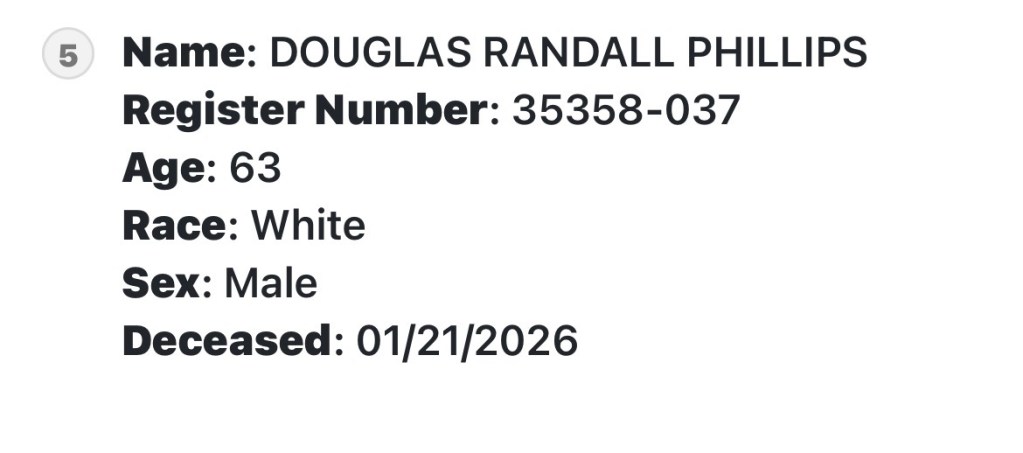
Loved Ones Coalition has received multiple reports concerning the death in custody of Douglas Randall Phillips (Register No. 35358-037), age 63, who died on January 21, 2026, while incarcerated at FCI McKean.
According to information provided by incarcerated witnesses, Mr. Phillips was described as healthy, active, and fully functional until approximately 30–60 days prior to his death, at which point he began experiencing a rapid and severe medical decline. Witnesses report progressive symptoms including difficulty breathing, impaired speech, and loss of motor function in both his arms and legs, ultimately rendering him unable to walk, stand, or independently use the restroom or shower.
Despite the visible and escalating nature of his condition, Mr. Phillips reportedly did not receive timely diagnostic evaluation or emergency intervention. Other incarcerated individuals were forced to assist him with basic hygiene and mobility needs, including lifting, washing, and toileting, due to his inability to care for himself.
Reports indicate that when medical evaluation was finally performed, diagnostic imaging was delayed by approximately two weeks, and even when Mr. Phillips was taken for an x-ray, he was reportedly made to wait an additional two hours until pill line concluded before further action was taken. Only after this delay was an ambulance called. Mr. Phillips later died.
Witnesses further report that Health Services staff mocked or dismissed Mr. Phillips’ condition, allegedly laughing and stating that he was “faking” his symptoms despite his obvious neurological and respiratory distress. If accurate, this conduct represents a profound breach of professional medical standards.
Additionally, reports indicate that prior to his death, Mr. Phillips was assigned to outdoor labor duties, including snow removal, without adequate protective clothing, despite deteriorating health. While designated snow crews reportedly received proper winter gear, other incarcerated workers — including Mr. Phillips — were required to shovel snow without appropriate equipment. Four days prior to his death, Mr. Phillips reportedly sought medical attention, was already confined to a wheelchair, and was given only a steroid injection before being returned to housing.
Taken together, these allegations raise serious concerns of medical neglect, unsafe work assignments, delayed emergency response, and potential deliberate indifference, culminating in a preventable death.
2. KEY ALLEGATION & VIOLATION TABLE
| Allegation | Policy / Statute Violated |
| Failure to provide timely diagnostic evaluation despite neurological and respiratory symptoms | BOP Program Statement 6031.04 (Patient Care) |
| Delayed emergency response and ambulance activation | BOP Program Statement 6031.04 |
| Disregard of serious medical complaints and mobility loss | Eighth Amendment (Deliberate Indifference Standard) |
| Assignment to physically demanding outdoor labor despite declining health | BOP Program Statement 1600.09 (Occupational Safety) |
| Failure to provide appropriate protective clothing for assigned labor | OSHA Safety Principles / BOP Safety Guidelines |
| Unprofessional conduct by Health Services staff | BOP Program Statement 3420.11 (Standards of Employee Conduct) |
| Reliance on incarcerated individuals for medical assistance and hygiene | ACA Health Care Standards |
3. DIRECT TESTIMONY / DIRECT QUOTES
- “I talked to him every morning. I worked right beside him for years.”
- “He started having trouble breathing and talking and lost all motor function in his legs and arms.”
- “Other inmates had to wash him and help him pull his pants down to use the toilet.”
- “If they would have given him an x-ray when he was first injured instead of two weeks later, I think he’d be alive.”
- “They made him wait until pill line was finished before doing anything.”
- “Medical was laughing, saying he was faking.”
- “They just gave him a steroid shot and sent him back.”
4. STAFF IDENTIFIED IN TESTIMONY
- Health Services Staff — individual names not provided in testimony; conduct described collectively as dismissive, mocking, and non-responsive to medical distress.
- Work Assignment Supervisors — responsible for assigning outdoor labor duties without adequate protective equipment.
5. SYSTEMIC IMPACT
- Breakdown in emergency medical triage and escalation.
- Unsafe labor practices placing medically vulnerable individuals at risk.
- Normalization of delayed care and symptom dismissal.
- Incarcerated individuals forced into caregiving roles due to staff inaction.
- Increased risk of preventable deaths in custody.
6. OVERSIGHT DEMANDS — FCI MCKEAN (NORTHEAST REGION)
- Immediate preservation of all medical records, sick call requests, diagnostic orders, and Health Services notes related to Douglas Randall Phillips.
- Preservation and review of surveillance footage, medical unit logs, and pill line schedules on dates relevant to delayed care.
- Identification of Health Services staff involved in Mr. Phillips’ care and response decisions.
- Review of work assignment records and safety equipment issuance for outdoor labor crews.
- Referral of this death to the DOJ Office of Inspector General for independent investigation.
- Written explanation addressing why emergency care was delayed despite visible neurological decline.
7. CONCLUSION
The death of Douglas Randall Phillips at FCI McKean presents serious indicators of medical neglect, unsafe labor practices, and potential deliberate indifference. Loved Ones Coalition places the Bureau of Prisons on notice that this death will remain under active oversight pending full transparency, accountability, and independent review
NORTHEAST REGION
FCI Schuylkill (PA)
1. SUMMARY OF ALLEGATIONS
Loved Ones Coalition has received multiple reports indicating systemic medical neglect, racially hostile conduct, and failure to respond to medical emergencies at FCI Schuylkill. The information provided reflects patterns of conduct affecting multiple incarcerated individuals, rather than isolated incidents.
Reports identify a registered nurse identified as “Mackenzie” as being involved in multiple incidents raising serious concerns regarding racial harassment, deliberate indifference to medical emergencies, and failure to provide basic standards of care.
In one reported incident, while a Black incarcerated individual was removed from his cell, Nurse Mackenzie and another staff member allegedly entered the cell and hung a monkey—brought from outside the facility—using a makeshift noose. The object was reportedly left hanging and visible upon the individual’s return. This conduct, if accurate, constitutes overt racial intimidation and creates a hostile and unsafe environment.
In a separate incident at the same facility, reports indicate that an incarcerated individual exhibiting clear signs of an evolving stroke sought medical attention and was told by Nurse Mackenzie to “go lay down and relax.” As symptoms escalated into a full stroke, multiple incarcerated individuals reportedly called for medical assistance. Nurse Mackenzie, who was the on-duty nurse at the time, allegedly did not respond. The following day, after a change in medical staff, the individual was transported to a hospital where a stroke was confirmed.
Beyond these acute incidents, Loved Ones Coalition has received reports of longstanding medical neglect affecting multiple individuals, including:
- Prolonged delays in diagnostic testing
- Physician-ordered evaluations and lab work being overridden or stalled
- Failure to provide timely specialty care
- Extended waiting periods for medically urgent consultations
In at least one instance, a facility physician, Dr. Byble, reportedly attempted to pursue appropriate diagnostic evaluation; however, medical orders were allegedly delayed or overridden by nursing staff, contributing to continued deterioration and heightened risk.
Taken together, these reports suggest systemic breakdowns in medical escalation, staff accountability, and oversight, placing incarcerated individuals at risk of preventable harm.
2. KEY ALLEGATION & VIOLATION TABLE
| Allegation | Policy / Statute Violated |
| Racially hostile conduct by medical staff | BOP Program Statement 3420.11 (Standards of Employee Conduct) |
| Failure to respond to neurological emergency symptoms | BOP Program Statement 6031.04 (Patient Care) |
| Deliberate indifference to medical emergencies | Eighth Amendment |
| Nursing interference with physician-ordered care | BOP Clinical Practice Guidelines |
| Prolonged delays in specialty diagnostics | BOP Program Statement 6031.04 |
| Failure to provide timely and adequate medical treatment | ACA Health Care Standards |
3. DIRECT TESTIMONY / DIRECT QUOTES
- “They went into his cell and hung a monkey with a makeshift noose.”
- “She told him to go lay down and relax.”
- “He started having a full-blown stroke and she never came.”
- “The next day, new staff sent him to the hospital and the stroke was confirmed.”
- “Orders for blood work were overridden.”
4. STAFF IDENTIFIED IN TESTIMONY
- Nurse Mackenzie — Registered Nurse, FCI Schuylkill
- Alleged racial harassment
- Alleged failure to respond to medical emergencies
- Dr. Byble — Physician, FCI Schuylkill
- Attempted to initiate diagnostic evaluation; orders reportedly delayed or overridden
5. SYSTEMIC CONCERNS
- Tolerance of racially hostile conduct by staff
- Failure to escalate medical emergencies appropriately
- Nursing interference with physician-directed care
- Chronic delays in diagnostics and specialty referrals
- Lack of effective medical oversight and accountability
6. OVERSIGHT DEMANDS — FCI SCHUYLKILL (NORTHEAST REGION)
- Immediate investigation into allegations involving Nurse Mackenzie, including preservation of staff logs, duty rosters, and available video footage.
- Review of medical response protocols for neurological and emergency presentations.
- Audit of cases where physician-ordered diagnostics or treatment were delayed, altered, or overridden.
- Evaluation of specialty care wait times and escalation procedures.
- Independent review of racially hostile conduct allegations and institutional response.
7. CONCLUSION
The reports concerning FCI Schuylkill demonstrate systemic failures in medical care delivery, staff oversight, and institutional accountability, compounded by allegations of racially hostile conduct. Loved Ones Coalition places the Bureau of Prisons on notice that these practices pose a serious risk to health, safety, and civil rights and warrant immediate corrective action.
NORTH CENTRAL REGION
FCI Thomson (Illinois)
1. SUMMARY OF ALLEGATIONS
Loved Ones Coalition has received multiple, corroborating reports indicating systemic exposure of incarcerated individuals to extreme cold conditions at FCI Thomson. The information reflects ongoing environmental and infrastructure failures affecting housing units, resulting in sustained cold exposure, recurring illness, and physical distress among the incarcerated population.
Reports describe housing units lacking adequate heat, with temperatures cold enough to cause visible ice formation on cell bars. Incarcerated individuals have reportedly become sick repeatedly due to prolonged exposure to cold indoor conditions, particularly overnight. Family members report loved ones waking with sore throats, respiratory irritation, and flu-like symptoms attributed to breathing frigid air while sleeping.
Multiple independent reports describe the same conditions, including cold cells, insufficient heating, and lack of effective remediation, indicating a facility-wide issue rather than isolated maintenance failures. Reports further note concern about worsening conditions during periods of below-zero outdoor temperatures.
Taken together, the information reflects systemic conditions-of-confinement failures that pose ongoing health risks and raise serious concerns regarding compliance with constitutional standards and basic habitability requirements.
2. KEY ALLEGATION & VIOLATION TABLE
| Allegation | Policy / Statute Violated |
| Prolonged exposure to extreme cold in housing units | Eighth Amendment – Conditions of Confinement |
| Failure to maintain habitable indoor temperatures | BOP Program Statement 4200.04 (Facilities Operations Manual) |
| Environmental conditions contributing to illness | BOP Program Statement 6031.04 (Patient Care) |
| Lack of timely remediation of known infrastructure failures | 28 C.F.R. § 551.90 |
| Indifference to health risks associated with cold exposure | Eighth Amendment – Deliberate Indifference Standard |
3. DIRECT TESTIMONY / DIRECT QUOTES
- “My LO just called. He has been sick constantly due to how cold it is in there.”
- “Do they not have working heat there?”
- “Same. I feel bad for him—he said he’s sick and he can’t keep warm.”
- “My husband been sick off and on for the exact same reason.”
- “His cell has ice on the bars.”
- “I understand concrete is cold, but something needs to be done to keep them warm.”
- “My son says he wakes every morning with a sore throat from breathing the frigid air overnight.”
- “I can’t imagine what they are going to feel like this weekend with temperatures below zero.”
4. SYSTEMIC CONCERNS
- Sustained failure to provide adequate heat in housing units.
- Recurrent illness linked to environmental exposure.
- Lack of timely corrective action despite multiple complaints.
- Increased risk of respiratory illness during extreme winter temperatures.
- Normalization of substandard living conditions inconsistent with humane confinement standards.
5. OVERSIGHT DEMANDS — FCI THOMSON (NORTH CENTRAL REGION)
- Conduct an immediate inspection of heating systems serving all affected housing units.
- Provide written confirmation of current indoor temperature readings and heating functionality.
- Preserve and produce maintenance records, work orders, and repair logs related to heating systems for the past 90 days.
- Implement immediate remedial measures to ensure habitable temperatures during winter conditions.
- Identify interim protections provided to incarcerated individuals during periods of heating failure.
- Provide written confirmation of corrective actions taken to prevent recurrence.
6. CONCLUSION
The conditions reported at FCI Thomson reflect systemic failures to maintain habitable living environments during winter conditions. Loved Ones Coalition places the Bureau of Prisons on notice that continued exposure of incarcerated individuals to extreme cold will remain under active oversight pending documented corrective action and compliance with constitutional and regulatory obligations.
NORTH CENTRAL REGION
FCI Leavenworth (KS)
1. SUMMARY OF ALLEGATIONS
Loved Ones Coalition has received multiple corroborating reports indicating systemic failures related to living conditions, heating infrastructure, sanitation, and emergency response at FCI Leavenworth. The information reflects facility-wide conditions, not isolated incidents, occurring during severe winter weather and extended lockdowns.
Reports indicate incarcerated individuals have been confined for prolonged periods in dangerously cold cells with inadequate heating, broken windows, insufficient bedding, and limited access to hygiene, while also being exposed to environmental health hazards including mold and rodent infestation. These conditions have coincided with multiple reported inmate deaths within a short timeframe, raising serious concerns regarding environmental contributors and emergency response protocols.
2. KEY ALLEGATION & VIOLATION TABLE
| Allegation | Policy / Statute Violated |
| Inadequate heating during extreme winter conditions | U.S. Const. Amend. VIII (Cruel and Unusual Punishment); BOP Program Statement 1600.09 (Facilities Operations) |
| Confinement in freezing cells due to broken windows and failed infrastructure | U.S. Const. Amend. VIII; 18 U.S.C. § 4042 |
| Insufficient bedding despite sub-freezing temperatures | BOP Program Statement 1600.11 (National Environmental Health and Safety) |
| Extended lockdowns without adequate heat or protection | U.S. Const. Amend. VIII |
| Mold present in housing units | BOP Program Statement 1600.11; Federal sanitation standards |
| Severe rodent infestation impacting food service areas | Federal health and sanitation standards |
| Failure to provide timely information and transparency following inmate deaths | 18 U.S.C. § 4042; Due Process considerations |
3. DIRECT TESTIMONY / DIRECT QUOTES
- “They have been on lockdown since 1/13 with no contact to anyone who has posted in the group.”
- “I’m assuming they haven’t even showered.”
- “My husband always calls when they are let up for showers and I haven’t heard anything.”
- “My loved one was found dead.”
- “They called and said he’s dead — that’s it.”
- “The cells are freezing, and the heat is not working.”
4. SYSTEMIC CONCERNS
- Reliance on outdated heating systems unable to maintain safe temperatures during winter storms
- Environmental hazards (mold and rodents) posing ongoing health risks
- Extended lockdown practices that exacerbate exposure to unsafe living conditions
- Lack of transparency and humane notification protocols following inmate deaths
5. OVERSIGHT DEMANDS — FCI LEAVENWORTH (NORTH CENTRAL REGION)
- Immediate independent investigation into heating failures, living conditions, and sanitation at FCI Leavenworth.
- Emergency remediation of heating systems, broken windows, mold contamination, and rodent infestation.
- Transparent reporting regarding recent inmate deaths, including timelines, cause of death determinations, and whether environmental conditions contributed.
- Immediate protective measures for individuals currently confined under unsafe or freezing conditions.
- Ongoing external oversight to ensure compliance and to prevent retaliation against individuals who report conditions.
6. CONCLUSION
The conditions documented at FCI Leavenworth present a serious and ongoing risk to human life. Continued inaction exposes incarcerated individuals to preventable harm and violates fundamental constitutional and statutory obligations. Immediate intervention is required.
SOUTH CENTRAL REGION
USP Beaumont (TX)
1. SUMMARY OF ALLEGATIONS
Loved Ones Coalition has received multiple reports indicating unsafe and potentially unconstitutional conditions of confinement at USP Beaumont. Testimony reflects prolonged exposure to extreme cold due to continuous air conditioning during winter months, extended lockdown conditions, denial of out-of-cell time, and severe restrictions on communication. These conditions appear to affect multiple housing units and are not isolated incidents, suggesting systemic operational failures impacting health, safety, and basic human needs.
2. KEY ALLEGATION & VIOLATION TABLE
| Allegation | Policy / Statute Violated |
| Continuous operation of air conditioning during winter | Eighth Amendment (Cruel and Unusual Punishment) |
| Prolonged and indefinite lockdown conditions | BOP Program Statement 5270.09 |
| Denial of regular out-of-cell time | 28 CFR § 541 |
| Restriction of phone access during limited releases | BOP Program Statement 5264.08 |
| Conditions resembling punitive segregation within general population housing | Eighth Amendment / Due Process |
3. DIRECT TESTIMONY / DIRECT QUOTES
- “They are blowing the AC.”
- “Lockdown has been in play since before Christmas.”
- “SHU inmates are in the dorm.”
- “They were coming out every so often for 20 minutes, now they aren’t coming out at all.”
- “Phones are off in the dorms when they do get out.”
- “The only option to communicate right now is email — if that.”
4. SYSTEMIC CONCERNS
- Use of prolonged lockdown as a default housing status rather than a temporary security measure
- Exposure to cold temperatures without adequate mitigation
- Communication restrictions preventing timely contact with family or advocates
- Conditions functionally mirroring segregated housing without procedural safeguards
5. OVERSIGHT DEMANDS — USP BEAUMONT (SOUTH CENTRAL REGION)
- Immediate review of HVAC operations and temperature controls within housing units.
- Documentation and justification for ongoing lockdown conditions extending beyond standard durations.
- Restoration of regular out-of-cell time consistent with BOP policy.
- Immediate reinstatement of phone access during all authorized movement periods.
- Independent oversight to assess whether current conditions constitute punitive confinement without due process.
6. CONCLUSION
The conditions reported at USP Beaumont raise serious concerns regarding health, safety, and constitutional compliance. Continued inaction places incarcerated individuals at risk of physical harm and violates established standards of confinement. Prompt intervention and oversight are required.
SOUTH CENTRAL REGION
FCI Texarkana (TX)
1. SUMMARY OF ALLEGATIONS
Loved Ones Coalition has received multiple reports alleging systemic case management failures and unprofessional conduct by supervisory staff at FCI Texarkana. Testimony reflects a breakdown in release processing, disregard for inmate inquiries regarding overdue release actions, and openly hostile behavior by staff responsible for reentry coordination. The reported conduct appears to affect multiple individuals and suggests a pattern of administrative obstruction rather than isolated interpersonal conflict.
2. KEY ALLEGATION & VIOLATION TABLE
| Allegation | Policy / Statute Violated |
| Failure to process releases in a timely manner | BOP Program Statement 5800.15 |
| Incompetence in case management duties | BOP Program Statement 5322.13 |
| Retaliatory and hostile response to formal inmate inquiries | First Amendment / BOP Policy |
| Destruction and disregard of formal cop-out requests | 28 CFR § 542 (Administrative Remedy Program) |
| Unprofessional conduct by supervisory staff | BOP Standards of Employee Conduct |
3. DIRECT TESTIMONY / DIRECT QUOTES
- “There are case managers here that don’t know the slightest thing about the position they’re in.”
- “When people presented cop-outs about their release being overdue, he threw them on the floor and stomped on them.”
- “He said, ‘You’re not going to tell me how to do my job.’”
- “Very unprofessional.”
4. STAFF IDENTIFIED IN TESTIMONY
- Hawkins — Case Manager, FCI Texarkana
- Alleged lack of basic knowledge regarding case management responsibilities
- Ankton — Unit Manager, FCI Texarkana
- Alleged obstruction of release processing
- Alleged hostile and retaliatory conduct toward inmates submitting formal inquiries
5. OVERSIGHT DEMANDS — FCI TEXARKANA (SOUTH CENTRAL REGION)
- Immediate review of overdue release cases assigned to the identified unit.
- Audit of case management practices and compliance with release-processing timelines.
- Investigation into allegations of destruction of formal inmate requests.
- Review of staff conduct for compliance with BOP professionalism standards.
- Implementation of corrective oversight to prevent retaliation against individuals seeking release clarification.
6. CONCLUSION
The allegations at FCI Texarkana reflect a serious breakdown in case management integrity and supervisory accountability. Failure to address these practices risks unlawful detention, erosion of due process, and continued harm to individuals entitled to timely release consideration.
SOUTH CENTRAL REGION
FCI Forrest City (AR)
1. SUMMARY OF ALLEGATIONS
Loved Ones Coalition has received multiple corroborating reports indicating prolonged loss of hot water, unsafe food handling practices, and extended lockdown conditions at FCI Forrest City (Low and Medium). Reports state that both facilities have been without hot water for over two weeks during sub-freezing winter temperatures, including lows as cold as 2°F. The absence of hot water has prevented inmates from washing hands, sanitizing dishes, or maintaining basic hygiene during flu and COVID season. Reports further indicate that malfunctioning kitchen equipment has resulted in improperly handled meals being served hours after preparation, creating serious health risks. These conditions reflect systemic infrastructure failures rather than isolated incidents.
2. KEY ALLEGATION & VIOLATION TABLE
| Allegation | Policy / Statute Violated |
| Prolonged lack of hot water in inmate housing | Eighth Amendment (Cruel and Unusual Punishment) |
| Inability to sanitize dishes or wash hands | BOP Program Statement 6031.04 (Inmate Hygiene & Sanitation) |
| Unsafe food handling and delayed meal service | BOP Program Statement 4700.06 (Food Service Manual) |
| Extended lockdowns in freezing conditions without adequate heat or sanitation | Eighth Amendment; 28 C.F.R. § 541 |
| Failure to address infrastructure failures in extreme weather | BOP Facilities Operations Standards |
3. DIRECT TESTIMONY / DIRECT QUOTES
- “They have been without hot water for over two weeks.”
- “It’s 18 degrees and as low as 2 degrees, and they can’t even wash their hands.”
- “The dishwasher doesn’t work because the booster heater is out — there’s no hot water to sanitize the dishes.”
- “Lunch was served at noon, dinner was given in boxes at 2pm, and the food sat out for hours.”
- “Bacteria grows in food that’s been heated and cooled and not brought back up to temperature.”
- “This is flu season and COVID, and they can’t sanitize anything.”
- “They are locked down because of snow and ice with no hot water at all.”
4. SYSTEMIC IMPACT
The reported conditions create widespread health risks affecting the entire incarcerated population at both the Low and Medium facilities. The lack of sanitation, combined with improper food handling and extended lockdowns during extreme cold, exposes inmates to preventable illness, infection, and deterioration of physical health. These failures also heighten the risk of outbreaks and demonstrate systemic neglect of basic health and safety standards.
5. OVERSIGHT DEMANDS — FCI FORREST CITY (SOUTH CENTRAL REGION)
- Immediate restoration of hot water service at both Low and Medium facilities.
- Emergency inspection and repair of food service sanitation equipment, including booster heaters and dishwashing systems.
- Independent health and safety inspection addressing hygiene, food handling, and living conditions during winter weather.
- Immediate implementation of safe food temperature controls and revised meal distribution procedures.
- Written explanation for the prolonged failure to remedy these conditions and safeguards to prevent recurrence.
- Protection against retaliation for incarcerated individuals who report these conditions.
6. CONCLUSION
The conditions reported at FCI Forrest City represent serious and ongoing violations of constitutional and federal standards. Continued inaction places incarcerated individuals at unnecessary risk of illness and harm. Immediate oversight and corrective action are required.
WESTERN REGION
FCC Victorville (CA)
1. SUMMARY OF ALLEGATIONS
Loved Ones Coalition has received multiple, corroborating reports from incarcerated individuals housed at FCC Victorville indicating systemic failures in case management operations, interference with the Administrative Remedy Program, improper use of management variables, and prolonged denial of basic hygiene services. The information reflects a pattern affecting multiple individuals within the same housing unit and does not appear to be isolated error.
Reports indicate that required case management actions—including custody classification reviews, transfer paperwork, and prerelease preparation—are being delayed or not completed. Individuals with low custody scores and eligibility for transfer or lower security placement reportedly remain confined at higher security levels without written justification or notice.
In addition, multiple reports indicate that BP-8 and BP-9 administrative remedies intended for submission to the Warden are being obstructed, rerouted, or not processed, effectively preventing individuals from accessing the formal grievance process.
Separate but concurrent reports indicate prolonged denial of hot or warm water for showers, forcing individuals to bathe in freezing water or go extended periods without access to hygiene. These conditions raise serious concerns regarding sanitation, health, and compliance with minimum standards of confinement.
2. KEY ALLEGATION & VIOLATION TABLE
| Allegation | Policy / Statute Violated |
| Failure to process custody classification reviews and transfer paperwork | BOP Program Statement 5100.08 (Inmate Security Designation and Custody Classification) |
| Improper placement or maintenance of management variables without notice or justification | BOP Program Statement 5100.08; Fifth Amendment (Due Process) |
| Interference with BP-8 and BP-9 Administrative Remedy filings | 28 C.F.R. § 542.10–542.19 (Administrative Remedy Program) |
| Denial of access to unit team members and counselors | BOP Program Statement 5322.13 (Inmate Classification and Program Review) |
| Retaliatory or obstructive conduct impacting transfer and release preparation | First Amendment; BOP Program Statement 3420.11 (Standards of Employee Conduct) |
| Prolonged denial of hot or warm water for hygiene | Eighth Amendment; BOP Program Statement 1600.09 (Occupational Safety and Environmental Health) |
3. DIRECT TESTIMONY / DIRECT QUOTES
- “BP-9 grievances that are supposed to go to the Warden keep ending up back on his desk and dying there.”
- “This officer is the reason inmates never get to team or speak to the counselor.”
- “He’s been here over a year and still hasn’t had his transfer paperwork processed.”
- “A management variable was put on him and he was never served paperwork or told why.”
- “Custody points are low and not even high enough to justify being at a USP.”
- “No hot showers. Not even warm water. Sometimes days go by without being allowed to shower.”
4. STAFF IDENTIFIED IN TESTIMONY
Officer Strong — Case Manager, FCC Victorville
Testimony from multiple incarcerated individuals within the same unit identifies Officer Strong as associated with the following alleged conduct:
- Alleged failure to process BP-8 and BP-9 grievances
- Alleged obstruction of grievances intended for the Warden
- Alleged failure to file or complete transfer paperwork
- Alleged placement or maintenance of unexplained management variables
- Alleged denial of access to unit team and counselor services
Multiple incarcerated individuals report similar experiences involving this staff member, indicating a pattern rather than an isolated incident.
5. OVERSIGHT DEMANDS — FCC VICTORVILLE (WESTERN REGION)
- Conduct an immediate audit of case management practices within the affected housing units.
- Review all management variables applied during the relevant period and identify those lacking notice or justification.
- Audit Administrative Remedy processing to ensure BP-8 and BP-9 filings are not obstructed or improperly rerouted.
- Ensure incarcerated individuals have timely access to unit team members and counselors as required by policy.
- Restore consistent access to hot water for showers and hygiene.
- Implement safeguards to prevent retaliation against individuals reporting these conditions.
6. CONCLUSION
The allegations at FCC Victorville reflect systemic failures in case management accountability, grievance processing, and basic living conditions. Loved Ones Coalition places the Bureau of Prisons on notice that continued obstruction of administrative remedies and deprivation of hygiene services will remain under active oversight pending documented corrective action.
WESTERN REGION
FCI Mendota (CA)
1. SUMMARY OF ALLEGATIONS
Loved Ones Coalition has received multiple, separate reports concerning serious misconduct and medical neglect at FCI Mendota.
These include:
- The arrest of a Bureau of Prisons correctional officer assigned to FCI Mendota on felony sexual assault charges involving minors, raising urgent concerns about institutional safety, screening, and oversight.
- Medical neglect involving the interruption of Hepatitis C treatment during transfer, followed by a mini stroke (TIA) and an alleged failure to provide timely neurological follow-up or restart prescribed treatment.
The information reflects distinct but concurrent failures involving staff conduct and medical care, each posing serious risk to incarcerated individuals.
2. KEY ALLEGATION & VIOLATION TABLE
Allegation Table — FCI Mendota (CA)
| # | Allegation | Description | Potential Violations |
| 1 | Criminal sexual misconduct by staff | A correctional officer employed at FCI Mendota was arrested and charged with felony sexual offenses involving a minor | DOJ ethics standards; BOP employee conduct policies; public safety obligations |
| 2 | Failure of institutional safeguards | Arrest raises concerns regarding hiring, monitoring, supervision, and internal reporting mechanisms | BOP PREA standards; duty to protect; internal affairs oversight |
| 3 | Interruption of active Hepatitis C treatment | Individual was transferred mid-treatment without a medical hold, causing abrupt discontinuation of prescribed Hep C medication | Deliberate indifference to serious medical need; Eighth Amendment |
| 4 | Failure to restart Hepatitis C treatment | After transfer, prescribed Hep C treatment was not resumed | BOP Clinical Practice Guidelines; continuity-of-care requirements |
| 5 | Failure to provide neurological follow-up after TIA | Individual reportedly suffered a mini stroke (TIA) and did not receive proper neurological evaluation or follow-up care | Eighth Amendment; medical negligence |
| 6 | Delayed or absent response to Report a Concern submission | Family reports submitting a Report a Concern with no response or updates | Administrative failure; oversight breakdown |
3. DIRECT TESTIMONY / DIRECT QUOTES
- “My loved one was transferred while actively in the middle of Hepatitis C treatment. He should have been placed on a medical hold, but instead the transfer went through and his medication was stopped.”
- “Not long after arriving at the new facility, he suffered a mini stroke (TIA).”
- “He still hasn’t received proper neurological follow-up, and his Hep C treatment has not been restarted.”
- “I submitted a Report a Concern through the BOP website and haven’t received any updates.”
4. STAFF IDENTIFIED IN REPORTING
- Santiago Flores — Correctional Officer, FCI Mendota
- Arrested on felony sexual assault charges involving a minor
- Law enforcement confirmed employment with the Federal Bureau of Prisons at FCI Mendota at the time of arrest
(No medical staff names provided in the submitted medical testimony.)
5. OVERSIGHT DEMANDS
Loved Ones Coalition is requesting:
- Full disclosure regarding the employment status, access level, and prior complaints involving the arrested staff member
- Review of PREA compliance, staff supervision, and reporting procedures at FCI Mendota
- Immediate medical review of treatment interruptions and current care statuses
- Confirmation and response to the submitted Report a Concern
- Assurance of protection from retaliation for individuals reporting these issues
STATEMENT REGARDING JANUARY 21, 2026 FIRST STEP ACT VIDEO
On January 21, 2026, the Bureau of Prisons released a public video featuring Lauren Lambert, Chief of the Office of Public Affairs, in conversation with Rick Stover, Special Assistant to the Director and designated First Step Act (FSA) subject matter expert.
Loved Ones Coalition acknowledges the Bureau’s stated intent to provide clarity regarding First Step Act implementation. However, feedback received from incarcerated individuals, families, advocates, and frontline observers reflects widespread concern that the explanations provided do not align with lived implementation across facilities — including those documented in this report.
Specifically, the characterization of ongoing First Step Act failures as being in “growing stages” is inconsistent with statutory timelines and operational reality. The First Step Act was enacted in 2018. Its core provisions regarding earned time credits, individualized placement determinations, and prerelease custody were not aspirational goals, but mandatory directives. Capacity constraints, contracting limitations, or administrative backlog do not suspend statutory obligations.
This report documents repeated instances in which:
- Earned Time Credits are calculated inconsistently or not applied at all
- Eligible individuals remain confined at higher security levels without written justification
- Home confinement and prerelease placement determinations are delayed or denied without individualized assessment
- Case managers fail to apply full FSA and SCA credits reflected in Bureau guidance
- Grievances raising these issues are obstructed, rerouted, or ignored
These failures are not theoretical. They appear across regions, custody levels, and institutions, including facilities documented in this report. The cumulative impact is prolonged incarceration beyond lawful timelines, erosion of trust in statutory compliance, and increased strain on both incarcerated populations and staff.
Of particular concern is the implication that logistical or contractual limitations — including Residential Reentry Center (RRC) bed space — justify delayed or selective implementation. Federal law does not condition compliance on convenience. The statute explicitly provides alternatives, including direct home confinement, when criteria are met.
The Bureau’s public messaging must reconcile with on-the-ground reality. Absent that alignment, statements intended to reassure instead deepen distrust and compound confusion for families attempting to understand why lawful credits are not being honored.
Loved Ones Coalition submits this report to document that the concerns raised in response to the January 21 video are not isolated reactions, but are substantiated by systemic evidence across multiple facilities. Until implementation matches statutory mandate, public explanations will continue to be contradicted by lived outcomes.