December 8, 2025 – Federal Oversight Report
LOVED ONES COALITION
Weekly Oversight Report
Documenting Systemic Violations Across the Federal Bureau of Prisons
Reporting Period: December 1-8, 2025
PREVENTABLE DEATHS IN A SYSTEM THAT REFUSES TO CHANGE
On December 6 and 7, 2025, two men died in federal custody: Antonio Chester Lewis (Reg. No. 09875-007, age 51) and Edwin Denton (Reg. No. 28502-078, age 62). Both deaths were preventable. Both men repeatedly signaled that something was wrong. Both encountered a system that had the policies, protocols, and staffing on paper to protect them – and a culture in practice that simply chose not to.
This week’s Loved Ones Coalition Federal Oversight Report documents more than isolated failures. From FCC Hazelton to FCI Lewisburg, FCI El Reno Camp, Forrest City, Lompoc, Oakdale, Edgefield, Marianna, Three Rivers, Schuylkill, Leavenworth, Terre Haute, USP Lee and other facilities, we see the same pattern playing out in different uniforms and zip codes:
- Severe medical symptoms dismissed with “drink water and lay down.”
- Pneumonia and MRSA allowed to progress unchecked across two institutions.
- Chest pain ignored until a man collapses and dies.
- Heat and hot water out for weeks or months.
- Diesel heaters pumping fumes into occupied housing units.
- Sewage flooding SHU cells while staff say it’s “part of the punishment.”
- FSA/SCA credits withheld, team meetings faked, and men held months past their lawful release dates.
These are not capacity problems. They are will problems. The Bureau of Prisons has written policies that, if followed, would have protected Antonio Lewis and Edwin Denton. It has clinical guidance for chest pain, infectious disease, environmental hazards, and suicide risk. It has program statements for sanitation, food service, medical care, and release-credit recalculations. What it does not have – at many of these institutions – is a culture that values human life enough to follow its own rules.
For years, the BOP has argued that “staffing shortages” and “difficult populations” make full compliance hard. The evidence in this report points to something more fundamental: a control-first culture that uses deprivation, delay, and retaliation as tools of management. When staff respond to sewage in SHU by saying it is part of the punishment, when COs tell men in obvious cardiac distress to go back to their rooms, when case managers refuse to apply lawful FSA and SCA credits because they do not like being questioned, the problem is not that the system cannot comply – it is that too many people inside it believe they do not have to.
The truth is simple: these prisons will never be able to safely manage their current populations with the staff they have and the culture they operate under. You cannot starve people, freeze people, gas people with diesel fumes, ignore their infections and chest pain, then act surprised when they get sick and die. You cannot keep men and women months or years past their lawful release dates and call that “public safety.” What you are protecting is a broken system, not the public.
That means the solutions have to go beyond memos and talking points.
- Fix the First Step Act and Second Chance Act implementation gaps. Mandate real-time, auditable FSA/SCA recalculations and create consequences – including personal liability – when staff deliberately refuse to comply.
- Shrink the federal prison population. This is not optional. The BOP has demonstrated, facility after facility, that it cannot safely house, feed, or medically care for the number of people currently in its custody. The only moral and rational response is to drastically reduce that population.
Enforce real oversight and accountability. OIG, OIA, regional offices, U.S. Attorneys, and the courts must treat patterns of medical neglect, environmental abuse, and FSA/SCA sabotage as what they are: civil- and human-rights violations, not “operational issues.” Staff and leaders who falsify records, ignore emergencies, or retaliate against whistleblowers should not be shuffled to another post; they should be removed and, where appropriate, prosecuted.
This report is based on direct testimony from incarcerated people, families, and staff, backed by policy citations, public death records, and documented patterns we have tracked week after week. It is being transmitted to BOP leadership, regional directors, oversight bodies, and key members of Congress because the stakes are no longer abstract. They are measured in lives lost – lives like Antonio Chester Lewis and Edwin Denton, who should be alive today.
The Loved Ones Coalition is not asking for favors. We are demanding that every actor in this system – from line staff to wardens, from regional directors to the Department of Justice and Congress – do the jobs they already swore to do: protect those in custody, follow the law, and uphold the Constitution. Until the population is reduced, the laws are fixed, and this culture of deliberate indifference is confronted head-on, more families will get the call no one should ever receive.
We submit this week’s report in memory of those who died, in solidarity with those still inside, and as a clear record that the warning signs were there – and that no one can claim they did not know.
FCI LEWISBURG — Preventable Death of Antonio Chester Lewis (09875-007)
Systemic Medical Neglect Originating at FCC Hazelton → Fatal Outcome at FCI Lewisburg
NAME: ANTONIO CHESTER LEWIS
REGISTER NUMBER: 09875-007
AGE: 51
RACE: BLACK
SEX: MALE
DECEASED: 12/06/2025
. SUMMARY OF ALLEGATIONS
The Loved Ones Coalition received a formal death notification confirming that Antonio Chester Lewis, age 51, died on December 6, 2025, at FCI Lewisburg.
This case is deeply personal to LOC. We were in contact with his loved ones before and after his passing, and his death is now publicly acknowledged by his family and community across social media. They believed he was getting better. They believed he would come home. Instead, he died from conditions that were treatable, preventable, and allowed to deteriorate across two separate federal institutions.
Medical Neglect at FCC Hazelton
Credible evidence shows that while housed at FCC Hazelton, Mr. Lewis experienced severe and escalating symptoms consistent with:
- Pneumonia
- MRSA infection
- Respiratory distress
- Fever
- Weakness
- Untreated infection
Despite this, he reportedly received no:
- Diagnostic testing appropriate to his symptoms
- Emergency medical intervention
- Antibiotic treatment
- Required infectious disease precautions
He was ultimately transferred out of Hazelton while medically unstable — a direct violation of BOP medical-transfer protocol.
Deterioration and Death at FCI Lewisburg
Upon arrival at FCI Lewisburg, his condition rapidly deteriorated. He soon died from complications related to pneumonia and MRSA — both treatable conditions when properly managed. The collective evidence indicates:
- Delayed medical response
- Inadequate monitoring
- Breakdowns in continuity of care
- A preventable medical decline
- Violations of federal law, constitutional standards, and BOP policy
This was not a single-institution failure — it was a systemic collapse in medical care spanning FCC Hazelton → FCI Lewisburg.
| Allegation | Policy / Statute Violated |
| Failure to diagnose and treat pneumonia symptoms at Hazelton | P.S. 6031.04 (Patient Care); Eighth Amendment (Estelle v. Gamble) |
| Failure to identify, monitor, and treat MRSA infection | P.S. 6190.04 (Infectious Disease Management) |
| Delayed or absent medical evaluation despite severe respiratory distress | 18 U.S.C. § 4042(a)(2); P.S. 6031.04 |
| Improper transfer of a medically unstable individual | P.S. 5538.07 (Medical Transfers); P.S. 6000.05 (Health Services Manual) |
| Breakdown in continuity of care between Hazelton → Lewisburg | P.S. 6000.05 (Continuity of Care Requirements) |
| Failure to provide life-saving intervention prior to death | Eighth Amendment (Deliberate Indifference); Farmer v. Brennan |
| Negligence contributing to wrongful death | FTCA (28 U.S.C. §§ 1346(b), 2671–2680) |
3. DIRECT TESTIMONY — FAMILY STATEMENTS (PUBLIC)
These statements were posted publicly by Mr. Lewis’s loved ones within hours of his death. Their grief reveals the emotional reality and unanswered questions surrounding his preventable passing.
“We all anticipated you getting well & coming home.”
“You went home… home to paradise. We knew you fought.”
“I had never seen my brother Terriono Carter and Crandell Juice Edmonds cry so hard. I was absolutely helpless and stuck.”
“You will always and forever be our bodyguard.”
“BIG BRUH when I tell u getting this news u got called home hit me real hard… I’m really hurt bruh.”
“I’ma miss u so much… it really not sittin right rn with me.”
“This one is really hard for me… I appreciate all the calls, inboxes, and texts. Thank y’all.”
These statements paint a devastating picture:
His family believed he was recovering.
His death was sudden. And they are searching for truth and accountability
4. OVERSIGHT DEMANDS — FCI LEWISBURG (WITH REQUIRED FINDINGS AT FCC HAZELTON)
1. Immediate OIG Investigation
A full inquiry must include:
- Complete review of Hazelton & Lewisburg medical encounters
- Triage logs
- Diagnostic testing (or lack thereof)
- MRSA protocol compliance
- Staff interviews
- Timeline reconstruction
2. Office of Internal Affairs / OPR Review
To determine:
- Whether staff failed to provide required clinical assessments
- Whether delays violated BOP policy
- Whether misconduct or negligence contributed to his death
3. Release of All Relevant Medical Records
Including:
- Hazelton and Lewisburg clinical files
- Transfer documentation
- Nursing notes and vitals
- Medication orders (or omissions)
- Emergency response logs
4. Medical Practice Audit — Hazelton & Lewisburg
Assess:
- Pneumonia treatment protocol compliance
- MRSA isolation and treatment failures
- Adequacy of emergency responsiveness
- Continuity of care standards
- Whether staffing shortages played a role
5. Review of Medical Transfer Procedures
To determine:
- Why a clinically unstable individual was moved
- Whether P.S. 5538.07 was followed
- Whether Hazelton documented false stability
6. Mandatory Notification to Family
BOP must provide:
- Cause of death
- Detailed timeline of care
- Findings from all reviews
- Access to records under FTCA provisions
5. CONCLUSION
Antonio Chester Lewis should not have died. He was a 51-year-old father, brother, cousin, protector, and loved member of his community. His family believed he would recover and come home. Instead, he died from:
- A treatable respiratory illness
- A treatable infection
- Systemic failures across multiple federal institutions
This represents a catastrophic breakdown in medical duty, federal policy, and constitutional obligations. The Loved Ones Coalition stands with Antonio’s family — and we demand full investigation, accountability, and reform.
FCI SCHUYLKILL CAMP — Dangerous Use of Industrial Diesel Heaters, Extreme Heat Exposure, and Carbon Monoxide Risk
1. SUMMARY OF ALLEGATIONS
The Loved Ones Coalition received urgent, repeated reports from incarcerated individuals at FCI Schuylkill Camp describing a life-threatening environmental and safety emergency. According to multiple statements, the facility has no functioning heat, a known issue that has reportedly remained unresolved since last winter.
Instead of repairing the heating system, staff allegedly brought in large industrial diesel-powered heaters — clearly labeled “DO NOT USE IN OCCUPIED BUILDINGS — MUST BE WELL VENTILATED.”
These heaters were operated inside an occupied housing structure, pumping diesel exhaust directly into the living areas. Individuals report:
- Air saturated with diesel fumes
- Indoor temperatures exceeding 120°F
- Windows fully open with no relief
- Inability to breathe or cool the unit
- Extreme fear of carbon monoxide poisoning
Witnesses state the facility knew all year that the heat was broken but instead allocated funds to install 20+ new cameras and upgrade the gun range with moving targets, rather than addressing urgent infrastructure needs affecting human safety.
The conditions described present an immediate risk of heat stroke, asphyxiation, respiratory injury, and carbon monoxide poisoning, representing one of the most serious environmental and safety failures reported this week.
| Allegation | Policy / Statute Violated |
| Use of industrial diesel heaters inside an occupied building | P.S. 1600.11 (Environmental Health & Safety); OSHA ventilation standards; Eighth Amendment |
| Exposure to diesel fumes and potential carbon monoxide | 18 U.S.C. § 4042(a)(2) — Duty to Protect; P.S. 6031.04 (Medical Emergency Response) |
| Indoor temperatures exceeding 120°F | Eighth Amendment (unsafe temperature exposure); P.S. 1600.11 |
| Failure to repair heating system despite year-long notice | Facility Maintenance obligations under P.S. 4200.12 |
| Prioritizing cameras and gun-range upgrades over essential heating repairs | Misallocation of resources; dereliction of duty; P.S. 3420.09 (Standards of Conduct) |
| Risk of carbon monoxide poisoning due to unventilated diesel equipment | OSHA CO exposure standards; P.S. 1600.11 |
3. DIRECT TESTIMONY / DIRECT QUOTES
- “We have no heat so they rented big industrial diesel heaters which say on the door DO NOT USE IN OCCUPIED BUILDINGS — MUST BE WELL VENTILATED.”
- “They are pumping straight diesel fumes in the building on us.”
- “It was over 120 degrees in here this morning with every window in the building open.”
- “We can’t breathe.”
- “They knew all year the heat was still out from last year.”
- “Josh Smith needs to check this place out — it’s crazy here.”
- “Please get ahold of someone soon before we die of carbon monoxide poisoning.”
4. OVERSIGHT DEMANDS — FCI SCHUYLKILL CAMP (NORTHEAST REGION)
The Loved Ones Coalition formally requests:
1. Immediate Cessation of Diesel Heater Use
These heaters are clearly labeled unsafe for occupied spaces. They must be shut down immediately.
2. Emergency Environmental and Air Quality Assessment
Including:
- Carbon monoxide level testing
- Diesel particulate measurement
- Ventilation system inspection
- OSHA-compliant hazard review
3. Emergency Medical Checks for All Exposed Individuals
Screening for:
- CO poisoning
- Heat exhaustion / heat stroke
- Respiratory irritation or damage
- Headaches, dizziness, nausea
4. Immediate Repair of the Facility’s Heating System
A full facilities audit should determine:
- Why repairs were delayed for a year
- Whether funds were diverted to non-essential upgrades
- Who approved the ongoing hazardous workaround
5. Accountability Review
Evaluate:
- Decision-making around the use of diesel heaters
- Failure to prioritize critical infrastructure
- Potential misconduct or negligence
6. Notification to Regional Leadership
Given the acute danger, the Northeast Regional Office should:
- Issue an immediate corrective action order
- Confirm a remediation timeline
- Provide written updates to incarcerated individuals and their families
FCC HAZELTON — Systemic Denial of Dental Care, Infection Risks, Fever Symptoms, and Unsafe Living Conditions During Extended Lockdown
1. SUMMARY OF ALLEGATIONS
The Loved Ones Coalition received multiple reports from incarcerated individuals at FCC Hazelton describing widespread, systemic barriers to accessing emergency dental and medical care, exacerbated by an extended lockdown beginning November 26.
Multiple witnesses reported experiencing severe dental pain, gum swelling, suspected infection, and morning fever symptoms, yet remain unable to obtain timely evaluation or treatment. Individuals describe:
- Dental services available only once per week, creating dangerous delays
- Movement restrictions during lockdown that prevented access to clinical care
- Multiple written emergency requests submitted between November 29 and December 3 that received no response
- Correctional staff allegedly refusing to process medical requests, even when individuals displayed visible symptoms
In addition to medical neglect, incarcerated individuals report serious infrastructure failures, including:
- No heat for up to three weeks
- No functioning toilets for up to three weeks, requiring manual flushing with mop buckets
Unsanitary conditions and limited access to hygiene resources - Lockdown procedures preventing individuals from accessing essential services
These conditions collectively represent a facility-wide failure of medical care, environmental safety, sanitation, and basic constitutional protections, placing hundreds of incarcerated individuals at risk of infection, illness, and hazardous living conditions.
2. KEY ALLEGATION & VIOLATION TABLE
| Systemic Allegation | Policy / Statute Violated |
| Widespread inability to access emergency dental care | P.S. 6400.03; P.S. 6031.04 |
| Staff refusal to submit medical/dental requests | P.S. 3420.09; Eighth Amendment |
| Ignored emergency medical/dental kites | P.S. 6031.04 (Timely Access to Care) |
| Lockdown conditions blocking essential treatment | 18 U.S.C. § 4042(a)(2) |
| Persistent fever symptoms without medical evaluation | P.S. 6031.04 (Emergency Response) |
| No heat for up to three weeks | P.S. 1600.11 (Environmental Safety) |
| No functioning toilets for up to three weeks | P.S. 1600.11 (Sanitation Standards); Eighth Amendment |
3. DIRECT TESTIMONY / DIRECT QUOTES
- “Dental is only open one day a week — no one could be seen during lockdown.”
- “Many of us put in kites with no response.”
- “People have swelling, infection signs, fevers, and no access to medical.”
- “A CO refused to put in a medical request and walked away.”
- “We have no heat for weeks.”
- “We have no functioning toilets — we have to flush with a mop bucket.”
- “No one can get treatment until lockdown is over, no matter how bad it gets.”
4. OVERSIGHT DEMANDS — FCC HAZELTON
1. Immediate Emergency Medical & Dental Access
- Emergency triage for infection, fever, abscess, and pain
- Review all unanswered medical/dental requests
2. Investigation of Staff Conduct
- Refusal to process medical requests
- Ignoring visible medical symptoms
- Compliance with lockdown medical protocols
3. Heating & Sanitation Remediation
- Immediate restoration of heat
- Repair all toilets and sanitation systems
- Compliance review under P.S. 1600.11
4. Lockdown Medical Access Protocol Audit
- Determine how emergencies are handled during restrictive movement
- Ensure constitutional standards for care are met
5. Facility-Wide Medical Screening
For those reporting:
- Dental infections
- Fever
- Swelling
- Systemic infection indicators
6. Corrective Action Plan From Leadership
Including timelines for:
- Infrastructure repairs
- Improved medical access during future lockdowns
- Accountability for maintenance delays and resource allocation
USP LEE — Prolonged Loss of Heat and Hot Water, Rising Illness, and Environmental Health Failures
1. SUMMARY OF ALLEGATIONS
The Loved Ones Coalition received multiple independent reports indicating severe and prolonged environmental failures at USP Lee. According to testimonies from several families and individuals housed inside, the facility has been operating with no heat and no hot water for an extended period, with reports indicating the loss of hot water has persisted for up to two months.
Incarcerated individuals report being forced to take cold showers in winter temperatures, often entering only briefly to wash essential areas due to the extreme cold. These conditions are contributing to widespread illness inside the facility. Both incarcerated individuals and staff describe sudden-onset sickness among men who had been reported healthy the previous night, suggesting that chronic cold exposure, lack of hot water, and inadequate temperature regulation may be driving rapid health deterioration.
Family members report difficulty reaching their loved ones, with individuals spending entire days in bed due to feeling unwell — a drastic change from their reported condition the day before.
Despite the seriousness of the situation, individuals report no communication, no timeline for repair, and no indication that the heating or hot water systems will be restored in the immediate future.
The combination of cold exposure, lack of sanitary hot water access, sudden increases in illness, and absence of corrective action reflects a systemic failure to protect the health and safety of all individuals housed at USP Lee, in violation of BOP environmental and constitutional standards.
2. KEY ALLEGATION & VIOLATION TABLE
| Systemic Allegation | Policy / Statute Violated |
| Prolonged loss of heat in the facility | P.S. 1600.11 (Environmental Health & Safety); Eighth Amendment |
| No hot water for up to two months | P.S. 1600.11 (Sanitation & Hygiene Requirements) |
| Sudden-onset illness described by both staff and incarcerated individuals | P.S. 6031.04 (Patient Care); 18 U.S.C. § 4042(a)(2) |
| Failure to maintain minimum living temperatures and safe conditions | Eighth Amendment — deliberate indifference to unsafe conditions |
| Lack of communication or remediation plan from leadership | P.S. 3420.09 (Standards of Conduct; Dereliction of Duty) |
3. DIRECT TESTIMONY / DIRECT QUOTES
- “They haven’t had any heat or hot water in a long time.”
- “He’s been taking cold showers for over a month — he only stays in long enough to wash his important parts.”
- “Staff and inmates are describing people getting sick overnight.”
- “Temperatures like this with no heat and no hot water are making these men sick.”
- “There has been no hot water at USP Lee going on two months now — it’s way too cold for that.”
- “What can be done to ensure they have proper water and heat?”
4. OVERSIGHT DEMANDS — USP LEE (MID-ATLANTIC REGION)
1. Immediate Restoration of Heat and Hot Water
USP Lee must restore:
- Facility-wide heating
- Hot water access
- Compliance with minimum environmental safety standards under P.S. 1600.11
2. Emergency Environmental Health Inspection
Conducted by:
- BOP Regional Environmental Health & Safety Team
- Independent environmental inspectors if necessary
Inspection must include:
- Temperature monitoring
- Hot water system assessment
- Identification of heating system failures
3. Immediate Medical Screening
Due to reported illness connected to environmental exposure, the facility must evaluate individuals for:
- Fever
- Respiratory infections
- Cold-related illness
- Fatigue and sudden-onset health symptoms
4. Sanitation & Hygiene Compliance Review
USP Lee must ensure:
- Hot water for bathing
- Safe access to hygiene resources
- Compliance with sanitation and health requirements under P.S. 1600.11
5. Accountability Review of USP Lee Leadership
To determine:
- Why heat and hot water failures persisted for weeks to months
- Whether timely maintenance requests were filed
- Whether leadership took appropriate steps to protect those in custody
- Whether failure to act constitutes negligence or misconduct
6. Written Corrective Action Plan
USP Lee must produce a detailed plan outlining:
- Repair timelines
- Preventative maintenance actions
- Emergency response planning for environmental failures
USP MCCREARY — Starvation-Level Meal Portions, Constant Lockdowns, and Retaliatory Conditions Following Staff Injury
1. SUMMARY OF ALLEGATIONS
The Loved Ones Coalition received multiple reports from incarcerated individuals and family members indicating that USP McCreary is operating under severe, chronic deprivation conditions, including starvation-level food portions, constant lockdowns, and possible retaliatory treatment following a reported incident in which a correctional officer was injured.
Witness statements describe that since the staff injury, meal portions have been drastically reduced to the point where individuals report feeling physically weak, hungry, and unable to sustain normal functioning. These “trays” are described as “starvation portions,” with individuals relying entirely on commissary — and in many cases, the support of other families — to avoid prolonged hunger.
Reports also indicate near-constant lockdowns, significantly restricting access to movement, programming, recreation, and basic daily functions. These conditions have allegedly persisted for extended periods, contributing to:
- Nutritional deprivation
- Mental and physical fatigue
- Elevated stress and anxiety
- Disrupted sleep and increased isolation
Testimony suggests a pattern of punitive environmental conditions tied to staff grievances or security incidents, raising serious concerns about misuse of lockdowns and the weaponization of food deprivation.
These allegations point to systemic violations of health, safety, and constitutional protections, and require immediate oversight intervention.
2. KEY ALLEGATION & VIOLATION TABLE
| Systemic Allegation | Policy / Statute Violated |
| Starvation-level meal portions | P.S. 4700.06 (Food Service Manual); Eighth Amendment (nutritional adequacy) |
| Food deprivation following a staff injury (possible retaliation) | P.S. 3420.09 (Standards of Employee Conduct); Eighth Amendment — deliberate indifference |
| Constant and prolonged lockdowns restricting movement and access | 18 U.S.C. § 4042(a)(2); P.S. 5290.15 (Use of Restrictive Movement) |
| Conditions causing hunger, weakness, and dependence on commissary | Eighth Amendment; P.S. 4700.06 (Nutritional Requirements) |
| Lack of notice, transparency, or justification for ongoing restrictions | P.S. 5500.14 (Inmate Rights & Program Access) |
3. DIRECT TESTIMONY / DIRECT QUOTES
- “Since the CO got hurt, they’ve been starving them.”
- “The trays are starvation portions — nobody can live off this.”
- “If it wasn’t for having money on the books, they wouldn’t even be able to function.”
- “There are constant lockdowns — they barely get out.”
- “This feels like retaliation because a staff member got hurt.”
4. OVERSIGHT DEMANDS — USP MCCREARY (MID-ATLANTIC REGION)
1. Immediate Nutritional Audit
USP McCreary must undergo:
- Review of meal portion sizes
- Nutritional adequacy assessment
- Compliance review with P.S. 4700.06
- Comparison of current menus vs. approved BOP standards
2. Investigation of Alleged Retaliatory Treatment
Determine whether:
- Reduced food portions correlate with staff-related incidents
- Leadership authorized or ignored punitive deprivation
- Lockdowns are being misused as a disciplinary tool
3. Review of Lockdown Justification & Frequency
Assess:
- Duration and frequency of restrictive movement
- Compliance with P.S. 5290.15
- Whether essential services (medical, food, hygiene) were limited or denied
4. Immediate Corrective Action to Restore Adequate Nutrition
Facility must:
- Restore standard meal portions
- Ensure sufficient caloric intake
- Provide oversight of kitchen operations
5. Regional Oversight Intervention
The Mid-Atlantic Regional Office should:
- Conduct interviews
- Collect statements
- Verify the source of the deprivation
- Issue corrective directives
6. Transparency & Communication Requirements
Leadership must provide:
- Written explanation of ongoing lockdowns
- Documented maintenance of meal standards
- Assurance of non-retaliatory conditions
FCI TERRE HAUTE CAMP — No Hot Water, Cold Showers, and Extremely Cold Indoor Temperatures
1. SUMMARY OF ALLEGATIONS
The Loved Ones Coalition received reports indicating that FCI Terre Haute Camp is experiencing a severe and ongoing failure of essential environmental systems. According to multiple testimonies, the camp has no functioning hot water, forcing individuals to take cold showers despite extremely cold indoor temperatures.
These conditions have reportedly persisted for an extended period, leaving incarcerated individuals exposed to:
- Unsafe cold-water bathing
- Low indoor temperatures
- Physical discomfort and potential illness
- Lack of access to basic sanitation and hygiene protections
The reports suggest a complete breakdown in environmental maintenance, with no communication from the facility regarding repairs, temporary mitigation, or health safeguards for the individuals exposed to these conditions.
These failures present a significant risk of illness, hypothermia-related complications, and sanitation issues, and represent a systemic breakdown of environmental and health protections within the camp.
2. KEY ALLEGATION & VIOLATION TABLE
| Systemic Allegation | Policy / Statute Violated |
| No hot water in the camp | P.S. 1600.11 (Environmental Health & Safety) |
| Forced cold showers in unsafe temperatures | Eighth Amendment — deliberate indifference to unsafe conditions |
| Extremely cold indoor living areas | P.S. 1600.11 (Temperature Standards) |
| Lack of communication or timeline for repairs | P.S. 3420.09 (Standards of Conduct; Duty to Inform) |
| Potential illness from environmental exposure | P.S. 6031.04 (Patient Care); 18 U.S.C. § 4042(a)(2) |
3. DIRECT TESTIMONY / DIRECT QUOTES
- “Terre Haute camp has no hot water!”
- “They’re taking cold showers.”
- “It is extremely cold inside.”
4. OVERSIGHT DEMANDS — FCI TERRE HAUTE CAMP (NORTH CENTRAL REGION)
1. Immediate Restoration of Hot Water
FCI Terre Haute must:
- Repair the hot water system
- Restore safe showering conditions
- Ensure compliance with P.S. 1600.11
2. Environmental Safety Inspection
A full assessment is required to determine:
- Indoor temperature levels
- Functionality of water-heating systems
- Risks associated with cold exposure
3. Emergency Access to Safe Hygiene
Until repairs are complete, USP Terre Haute must provide:
- Temporary hot water access
- Safe shower alternatives
- Hygiene supplies
4. Medical Evaluation of Affected Individuals
Given the cold exposure, facility medical staff must screen for:
- Illness related to cold showers
- Respiratory issues
- Skin irritation or infection
- 5. Leadership Accountability Review
Investigate:
- How long the hot water system has been nonfunctional
- Whether leadership delayed repairs
- Why the camp failed to notify families or provide mitigation
6. Written Corrective Action Plan
The facility must provide a timeline including:
- Completion of repairs
- Preventative maintenance actions
- Environmental monitoring procedures
FCI LEAVENWORTH SATELLITE CAMP — Systemic Communication Failures, Food Deprivation, Expired Milk, and Exposure to Freezing Temperatures
1. SUMMARY OF ALLEGATIONS
The Loved Ones Coalition received multiple reports from both incarcerated individuals and staff documenting widespread operational breakdowns at the Leavenworth Satellite Camp. Staff themselves have reportedly expressed disgust and frustration at the conditions inside the facility, indicating that these failures are recognized internally and not limited to incarcerated individuals’ accounts.
Reports describe prolonged outages of computers and phone systems, preventing individuals from accessing legal communications or maintaining contact with their families. These outages have persisted for over a week, with phones reportedly half non-operational since May 2025.
Food service breakdowns are significant and recurring. Individuals report not receiving dinner on Thanksgiving, not receiving breakfast on several days prior, and receiving incomplete or mismatched PB&J ingredients. Milk is reportedly repeatedly expired, prompting complaints from both staff and incarcerated individuals.
Environmental conditions are reportedly unsafe. It is snowing outside and freezing inside, with no heat in the unit. Individuals lack adequate blankets, thermals, or winter clothing; commissary shelves are often depleted by the time they are allowed to purchase items.
These conditions, corroborated by internal staff dissatisfaction, reflect systemic failures in communication access, nutrition, sanitation, and basic environmental safety — and support the need for regional and national oversight intervention.
2. KEY ALLEGATION & VIOLATION TABLE
| Systemic Allegation | Policy / Statute Violated |
| Staff and incarcerated individuals reporting disgust with conditions | P.S. 3420.09 (Standards of Employee Conduct – safe environment obligations) |
| Nonfunctional computers blocking legal communications | Right of Access to Courts; P.S. 5265.14 |
| Phones down since May 2025 | P.S. 5264.08 (Telephone Access) |
| Missing meals, incomplete meals, expired milk | P.S. 4700.06 (Food Service Manual); Eighth Amendment (adequate nutrition) |
| Freezing indoor temperatures, no heat | P.S. 1600.11 (Environmental Health & Safety) |
| Lack of winter clothing / blankets | Eighth Amendment — deliberate indifference to health and safety |
| Failure to inform, repair, or mitigate | P.S. 3420.09 (Dereliction of Duty) |
3. DIRECT TESTIMONY / DIRECT QUOTES
These represent multiple individuals, including staff:
- “Computers are down and have been not working for over a week.”
- “They told the guys to just deal with it.”
- “We were not fed dinner on Thanksgiving.”
- “Some guys only got peanut butter. Others only jelly.”
- “Milk has been expired again lately.”
- “We’re freezing. There is no heat and we don’t have warm clothes.”
4. OVERSIGHT DEMANDS — FCI LEAVENWORTH SATELLITE CAMP (NORTH CENTRAL REGION)
1. Restore Communication Systems
- Immediate repairs to computers
- Full restoration of phones
- Provide temporary legal communication access
2. Emergency Food Service Audit
- Investigate skipped meals, incomplete meals, and expired milk
- Review compliance with P.S. 4700.06
- Require corrective measures to ensure adequate daily nutrition
3. Environmental Health Intervention
- Restore heat in all housing units
- Assess indoor temperatures
- Provide emergency blankets, gloves, thermals
4. Commissary Supply Correction
Ensure sufficient winter clothing and essential hygiene items.
5. Leadership Accountability Review
Determine whether:
- Staff complaints were ignored
- Repairs were delayed
- Food shortages were known but not addressed
6. Written Corrective Action Plan
Facility must provide timelines for:
- Repairs
- Food service correction
- Commissary resupply
- Preventative maintenance
FCI MARIANNA — Contaminated Water Exposure, Widespread Illness, Mail Shutdown, and Legal Access Obstruction
1. SUMMARY OF ALLEGATIONS
The Loved Ones Coalition received multiple reports indicating serious environmental and operational failures at FCI Marianna, including exposure to contaminated drinking water, sudden facility-wide illness, and a complete shutdown of mail and notary access for approximately one month.
Individuals report that following a major water break, the facility restored water service after approximately 24 hours — however, the water was reportedly discolored, unsafe, and consumed before proper clearance. According to multiple testimonies, many incarcerated individuals became sick shortly after drinking the water, with symptoms consistent with contaminated water exposure.
Simultaneously, the facility has reportedly stopped outgoing mail and suspended notary services, preventing individuals from sending legal documents, time-sensitive paperwork, and official correspondence. This effectively blocks access to the courts and prevents incarcerated individuals from meeting filing deadlines, executing affidavits, or completing administrative procedures.
These conditions raise serious concerns about environmental safety, public health, due process violations, and obstruction of constitutional rights, and require immediate oversight intervention.
2. KEY ALLEGATION & VIOLATION TABLE
| Systemic Allegation | Policy / Statute Violated |
| Exposure to contaminated or unsafe drinking water | P.S. 1600.11 (Environmental Health & Safety) |
| Widespread illness following water consumption | P.S. 6031.04 (Patient Care); 18 U.S.C. § 4042(a)(2) |
| One-month shutdown of mail services | P.S. 5265.14 (Correspondence); First Amendment rights |
| No notary access blocking legal filings | Right of Access to Courts; Bounds v. Smith; Lewis v. Casey |
| Failure to provide alternative legal communication channels | P.S. 1315.07; Constitutional Due Process |
| Lack of transparency and delayed response to environmental hazards | P.S. 3420.09 (Standards of Employee Conduct – Duty to Protect) |
3. DIRECT TESTIMONY / DIRECT QUOTES
- “After the water break, the water cleared up in 24 hours — but so many are sick now from drinking it.”
- “They stopped mail about a month ago.”
- “There are no notaries, so no one can get their legal mail out.”
- “It’s crazy how these places do stuff like this.”
4. OVERSIGHT DEMANDS — FCI MARIANNA (SOUTHEAST REGION)
1. Emergency Water Quality Investigation
- Immediate testing for contaminants
- Review of post-break procedures
- Verification of safe water status before re-use
- Public release of test results
2. Facility-Wide Medical Screening
Assess all affected individuals for:
- Gastrointestinal illness
- Dehydration
- Infection or exposure-related symptoms
- Delayed complications from contaminated water
3. Immediate Restoration of Mail Services
- Full reinstatement of outgoing mail
- Investigation into cause of month-long shutdown
- Written assurance that no facility can suspend mail without regional approval
4. Emergency Legal Access Protections
Until notary services are restored:
- Provide temporary authorized staff notaries
- Permit alternative verification methods
- Ensure indigent individuals can process legal mail
5. Accountability Review
Determine whether:
- Leadership failed to follow water safety protocols
- Mail and legal access restrictions were improperly imposed
- Illness reports were ignored or minimized
FCI EDGEFIELD — SHU Sewage Flooding, Retaliation for Complaints, Withheld Communication, and Inhumane Punitive Conditions
1. SUMMARY OF ALLEGATIONS
The Loved Ones Coalition received alarming reports from multiple sources regarding severe environmental contamination and retaliatory practices inside the Special Housing Unit (SHU) at FCI Edgefield.
According to consistent accounts, SHU cells are flooding with sewage, leaving floors covered in urine and feces. Individuals report being forced to remain in contaminated cells without cleaning supplies, sanitation measures, or safe relocation. Staff reportedly told individuals that “the conditions are part of the punishment,” suggesting deliberate indifference and the use of environmental hazards as a disciplinary tactic.
Testimonies also allege retaliation for reporting or complaining about the sewage flooding. Individuals who speak up are reportedly being denied their monthly phone call, and in some cases, mail is being withheld as punishment for attempting to report conditions.
The combination of fecal contamination, sewage exposure, retaliation, communication restrictions, and denial of basic rights constitutes a profound violation of health, safety, and constitutional standards. These are high-risk, high-severity allegations requiring immediate federal oversight.
2. KEY ALLEGATION & VIOLATION TABLE
| Systemic Allegation | Policy / Statute Violated |
| SHU cells flooding with urine and feces | P.S. 1600.11 (Environmental Health & Safety); Eighth Amendment |
| Staff stating sewage exposure is “part of the punishment” | Eighth Amendment – deliberate indifference; P.S. 3420.09 (Employee Conduct) |
| Retaliation for reporting unsafe conditions (loss of phone calls) | First Amendment Retaliation; P.S. 5264.08 (Telephone Access) |
| Withholding mail for complaints | P.S. 5265.14 (Correspondence); First Amendment rights |
| Denial of sanitary living conditions | 28 C.F.R. § 551.10–551.16 (Discipline); Eighth Amendment |
| Exposure to serious health hazards (biohazards, waste contamination) | P.S. 1600.11; 18 U.S.C. § 4042(a)(2) |
| Use of punitive environmental conditions | Eighth Amendment; federal case law (Hope v. Pelzer; Taylor v. Riojas) |
3. DIRECT TESTIMONY / DIRECT QUOTES
- “The cells are flooding with sewage.”
- “The cell floors are covered with urine and feces.”
- “Staff told them the conditions are part of the punishment.”
- “If they complain, they lose their monthly phone call.”
- “They are withholding their mail if they complain.”
- “This is beyond inhumane.”
4. OVERSIGHT DEMANDS — FCI EDGEFIELD (SOUTHEAST REGION)
1. Immediate Environmental Safety Intervention
- Emergency cleanup of all SHU cells
- Inspection by environmental health specialists
- Documentation of contamination levels
- Verification that no individual is housed in a biohazard environment
2. Medical Evaluation of All Affected Individuals
Assess for:
- Exposure to human waste
- Respiratory illness
- Skin infections
- Gastrointestinal issues
- Psychological harm due to extreme conditions
3. Retaliation Investigation
A review must determine whether:
- Phone calls were revoked to silence complaints
- Mail was withheld as punishment
- Staff engaged in intimidation or coercion
- Retaliation escalated after attempts to report or seek help
4. Legal & Communication Rights Restoration
- Immediate reinstatement of all phone calls
- Immediate release of withheld mail
- Assurance that individuals can report hazardous conditions without reprisal
5. Accountability & Conduct Review
The Southeast Regional Office must examine:
- Which staff made statements about “punishment”
- Whether leadership ignored or minimized sewage flooding
- Whether SHU conditions were intentionally allowed to deteriorate
6. Compliance Order & Corrective Action Plan
FCI Edgefield must produce a written plan addressing:
- Repairs to plumbing and drainage
- Preventative measures for future incidents
- Staff retraining on retaliation and constitutional protections
- Ongoing monitoring of SHU conditions
FCI OAKDALE I — Forced Signatures, Denial of Team Meetings, Retaliation for Asking About FSA Credits, and Systemic Refusal to Apply Time Credits
1. SUMMARY OF ALLEGATIONS
The Loved Ones Coalition received multiple reports alleging systemic First Step Act (FSA) violations at FCI Oakdale I, including coerced signatures on prefilled paperwork, denial of required team meetings, and retaliation against incarcerated individuals who inquire about their FSA Credits or Conditional Release calculations.
According to testimonies, correctional officers are forcing individuals to sign prefilled team-meeting documents under threat, without allowing them to participate in actual meetings or review their case information. When individuals attempt to ask about their FSA credits or request corrections, staff reportedly issue incident reports for “failure to comply” or “refusal of teams.”
Reports further allege that certain staff members are refusing to apply FSA Credits, refusing to conduct team meetings altogether, and disregarding the mandatory release calculation requirements outlined in the June 17, 2025 BOP directive.
These practices constitute systemic suppression of statutory rights, obstruction of early release mechanisms, misuse of disciplinary authority, and coercion under color of law.
2. KEY ALLEGATION & VIOLATION TABLE
| Systemic Allegation | Policy / Statute Violated |
| Forced signatures on prefilled forms | P.S. 5800.15 (Inmate Systems Management); Due Process Rights |
| Denial of legally required team meetings | FSA 18 U.S.C. § 3632(d); Program Statement 5410.01 |
| Retaliation for asking about FSA Credits | First Amendment Retaliation; P.S. 3420.09 (Employee Conduct) |
| False or retaliatory incident reports | 28 C.F.R. § 541; Due Process in Discipline |
| Refusal to apply earned FSA Credits | 18 U.S.C. § 3624(g); June 17, 2025 BOP Directive |
| Systematic obstruction of release calculations | FSA/SCA statutory compliance; 18 U.S.C. § 4042(a)(2) |
| Coercion and abuse of authority | P.S. 3420.09; Federal Employee Misconduct Standards |
3. DIRECT TESTIMONY / DIRECT QUOTES
- “The COs are forcing inmates to sign prefilled forms under threat.”
- “If an inmate asks anything about their FSA Credits, they get written up.”
- “They’re being written up for failure to comply and refusal of teams.”
- “The COs are flat-out refusing to apply FSA Credits.”
- “They don’t hold real team meetings — they’re not doing anything they’re supposed to do.”
4. OVERSIGHT DEMANDS — FCI OAKDALE I (SOUTH CENTRAL REGION)
1. Immediate Suspension of Coerced Documentation Practices
- Halt use of prefilled signature forms
- Require that all team meetings occur face-to-face with full participation
- Verify that no signatures were obtained under threat
2. Full Audit of FSA Credit Application
- Compare earned credits vs. applied credits
- Review all individuals past Conditional Release Dates
- Identify staff responsible for noncompliance
3. Investigation Into Retaliatory Incident Reports
Determine whether:
- Staff issued false or retaliatory write-ups
- Reports were used to block FSA eligibility
- Staff misused disciplinary authority to suppress questions
4. Mandatory Staff Retraining
Training on:
- June 17, 2025 directive
- FSA credit calculation
- Requirements for team meetings
- Standards of conduct prohibiting coercion and threats
5. Leadership Accountability Review
Regional oversight must determine:
- Whether leadership knew of coerced signatures
- Why team meetings were not occurring
- Whether staff intentionally obstructed release pathways
6. Corrective Action Plan
Oakdale must submit:
- A full schedule to conduct legitimate team meetings
- Verification that all FSA credits have been applied correctly
- A written prohibition against retaliation
FCI THREE RIVERS CAMP — Collapsed Plumbing, Biohazard Exposure, Administrative Neglect, Retaliation, and Improper Visitation Cancellation
1. SUMMARY OF ALLEGATIONS
The Loved Ones Coalition received extensive reports detailing dangerous environmental conditions, complete plumbing failures, biohazard exposure, and retaliatory staff practices at FCI Three Rivers Camp in Texas.
According to multiple sources, the camp’s two housing units — each divided into four wings — are experiencing chronic infrastructure failure, including shower drains that do not function, water pouring through cracks in the walls, black slimy clumps, and worm-like organisms emerging from the drainage system. Entire wings reportedly have no functioning sinks, no working urinals, and only one operational toilet for as many as 32 individuals.
The Camp Administrator, identified as Mr. Sanders, has been informed of these conditions repeatedly. Reports state that each time the issue is raised, he “pretends to know nothing of the situation.”
Additionally, incarcerated individuals report retaliation when concerns are raised. Staff allegedly respond to complaints by conducting shakedowns for contraband or threatening disciplinary action to silence further reports.
The facility also reportedly canceled visitation with no justification, causing families who traveled long distances and paid non-refundable lodging expenses to be turned away due to an unrelated contraband incident. The report states that the incident had nothing to do with visitation, but the facility used it as a reason to immediately cancel.
These allegations reflect severe sanitation failures, operational negligence, misuse of authority, and patterns of retaliation, all of which create significant health and safety risks.
2. KEY ALLEGATION & VIOLATION TABLE
| Systemic Allegation | Policy / Statute Violated |
| Shower drains failing; water pouring through cracks | P.S. 1600.11 (Environmental Health & Safety) |
| Black slime and worm-like organisms emerging | Environmental Hazard Standards; Eighth Amendment |
| Entire wings with no sinks, nonfunctional urinals, 1 working toilet | Minimum Sanitation Standards – 28 C.F.R. § 551.10; P.S. 1600.11 |
| Repeated reports ignored by administration | P.S. 3420.09 (Employee Conduct; Duty to Protect) |
| Retaliation for raising concerns | First Amendment Retaliation; P.S. 3420.09 |
| Improper cancellation of visitation | P.S. 5267.09 (Visiting Regulations) |
| Emotional and financial harm to families | BOP Family Contact Standards – 18 U.S.C. § 4042(a)(2) |
3. DIRECT TESTIMONY / DIRECT QUOTES
- “The shower drains have never worked properly — water pours from cracks in the walls.”
- “There’s black slimy clumps and some kind of worms that pour out.”
- “All the sinks don’t work. None of the urinals work. Only one toilet works.”
- “Mr. Sanders has been informed many times — he pretends to know nothing.”
- “My visitor drove 6 hours and paid for a motel in advance — visitation was canceled last minute for something unrelated.”
- “If you voice concerns, the staff shake the unit down to retaliate.”
- “It’s really just retaliation so you won’t bring the issues up anymore.”
4. OVERSIGHT DEMANDS — FCI THREE RIVERS CAMP (SOUTH CENTRAL REGION)
1. Immediate Environmental & Sanitation Intervention
- Emergency plumbing repairs
- Remediation of black slime, mold, and organic contamination
- Inspection for parasites or biohazards
- Temporary relocation of individuals if contamination persists
2. Full Facility Infrastructure Audit
Evaluate:
- Number of operational sinks, toilets, urinals
- Drainage system integrity
- Water intrusion or structural damage
- Compliance with P.S. 1600.11
3. Investigation of Administrative Negligence
Determine whether:
- Leadership ignored repeated reports
- Issues were intentionally minimized
- Unsafe conditions were knowingly permitted
4. Retaliation Inquiry
Review:
- Shakedown patterns after complaints
- Intimidation practices
- Staff responsible for punitive responses
5. Review of Visitation Cancellation Practices
Assess whether:
- Visitation cancellations followed P.S. 5267.09
- Families were improperly turned away
- Staff used unrelated incidents to block visitation access
6. Corrective Action Plan
The facility must outline:
- Immediate repair timelines
- Sanitation restoration
- Retaliation-prevention measures
- Transparent visitation protocols
FCI EL RENO CAMP — Death in Custody Following Repeated Denial of Medical Care, Ignored Cardiac Symptoms, CO Refusal to Assist, and FSA/SCA Noncompliance Concerns
Date of Death Reported: December 7, 2025
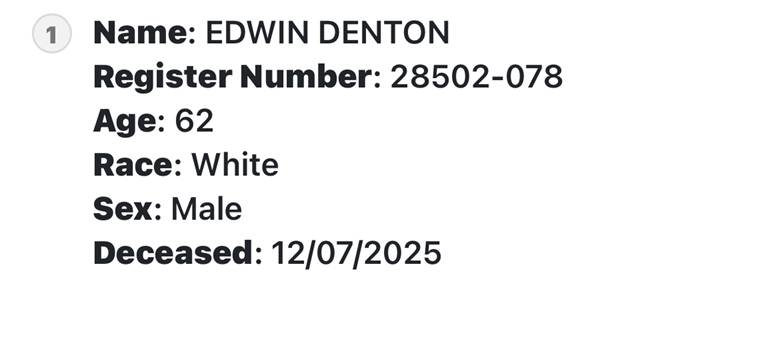
Deceased: Edwin Denton (Reg. No. 28502-078), Age 62
1. SUMMARY OF ALLEGATIONS
The Loved Ones Coalition received multiple independent reports regarding the in-custody death of Edwin Denton, age 62, at FCI El Reno Camp on or around December 7, 2025.
According to testimony, Mr. Denton sought medical care for three consecutive days, reporting acute chest pain and symptoms consistent with cardiac distress. Each time, medical staff allegedly told him to “drink water and lay down” and failed to perform any clinical evaluation consistent with BOP chest-pain protocols.
Late on the night of his death, witnesses report that Mr. Denton again experienced severe chest pain and approached the correctional officer on duty—identified only by last name Thilker. Instead of calling medical or initiating emergency protocols, CO Thilker allegedly responded:
“Go back to your fing room.”*
Mr. Denton died shortly afterward.
Multiple witnesses also stated that Mr. Denton should have already been released, and remained incarcerated only because his case manager failed to apply earned FSA and SCA credits, despite being eligible for release. This raises grave questions about whether illegal over-incarceration contributed to his preventable death.
These allegations describe a complete collapse of emergency medical response, deliberate indifference, and administrative noncompliance directly tied to liberty interest and safety.
2. KEY ALLEGATION & VIOLATION TABLE
| Systemic Allegation | Policy / Statute Violated |
| Repeated denial of care for cardiac symptoms | P.S. 6031.04 (Patient Care); Eighth Amendment |
| Failure to triage emergency chest pain | BOP Clinical Guidance – Chest Pain Protocol |
| CO refusal to contact medical during emergency | P.S. 5538.07 (Emergency Response); 18 U.S.C. § 4042(a)(2) |
| Disregard of obvious medical distress | Estelle v. Gamble; Farmer v. Brennan |
| Failure to apply earned FSA/SCA credits | 18 U.S.C. § 3624(g); June 17, 2025 FSA Directive |
| Prolonged custody due to administrative noncompliance | FSA/SCA statutory requirements; Due Process |
3. DIRECT TESTIMONY / DIRECT QUOTES
- “An inmate died because medical didn’t want to help him.”
- “He had gone to medical three days in a row.”
“They told him he was fine and to drink water and go lay down.” - “He went to the CO saying he was having bad chest pains.”
- “The CO told him, ‘Go back to your fing room.’”*
- “He would have already been home if the case manager had done his job with FSA and SCA.”
4. OVERSIGHT DEMANDS — FCI EL RENO CAMP (SOUTH CENTRAL REGION)
1. Immediate Death-in-Custody Investigation
To determine:
- Whether medical staff followed emergency protocols
- Whether chest-pain triage procedures were ignored
- Whether delays or refusals directly contributed to the death
2. Mandatory Review of All Medical Encounters
Including:
- Sick-call logs
- Clinical notes from all three days he presented
- Any staff-recorded dismissals or refusals
3. Emergency Response Review
Investigate:
- Whether CO Thilker failed to initiate emergency action
- Whether medical staff were notified
- Whether correctional and medical policy was followed
4. Full FSA/SCA Compliance Audit
Determine:
- Whether Mr. Denton was past his Conditional Release Date
- Whether improper credit withholding kept him in custody
- Whether this reflects systemic noncompliance at El Reno
5. Staff Accountability Review
For:
- Medical negligence
- Failure to provide emergency assistance
- Verbal misconduct
- Administrative failures related to lawful release processing
6. Transparency Requirements
BOP must:
- Disclose cause of death
- Provide a timeline of events
- Identify corrective measures implemented
5. CONCLUSION
The December 7, 2025 death of Edwin Denton appears to involve multiple, compounding failures:
- Ignored cardiac distress
- Repeated denial of medical evaluation
- Failure to initiate emergency response
- CO refusal to assist
- Administrative noncompliance with FSA/SCA resulting in unlawful prolonged incarceration
If substantiated, these actions constitute violations of constitutional protections, federal medical care requirements, and mandatory release-credit laws. The Loved Ones Coalition calls for immediate, public, and independent investigation.
FCI TERMINAL ISLAND — Systemic Falsification of Medical Records, Retaliatory Medical Transfers, Property Confiscation, and Misuse of SIS/SHU Placement
1. SUMMARY OF ALLEGATIONS
The Loved Ones Coalition received multiple reports from incarcerated individuals at FCI Terminal Island describing a systemic pattern of medical record falsification, retaliatory transfers, and misuse of the Special Housing Unit (SHU) following complaints, grievances, or tort claims.
According to consistent testimony, incarcerated individuals report:
- Unwarranted reductions in Care Level designations without an in-person exam or updated clinical assessment.
- Medical transfers initiated under inaccurate or falsified documentation, resulting in individuals being moved despite serious chronic conditions requiring higher-level care.
- Retaliatory SIS involvement after individuals file administrative complaints, FTCA tort claims, or request medical accommodations.
- Confiscation and destruction of personal property and legal documents during SHU placement.
- Fabricated disciplinary justifications (including allegations linked to 18 U.S.C. §1001 “false statements”) allegedly used to justify SHU placement.
- Failure to protect individuals with documented medical vulnerabilities, including those with cardiac conditions.
Witnesses describe these practices as retaliatory, medically negligent, and coordinated between departments, resulting in unsafe medical outcomes, denial of due process, and obstruction of access to courts. These allegations collectively represent a breakdown in medical integrity, patient-care compliance, investigative ethics, and constitutional protections at FCI Terminal Island.
2. KEY ALLEGATION & VIOLATION TABLE
| Systemic Allegation | Policy / Statute Violated |
| Reduction of Care Level without exam or clinical justification | P.S. 6031.04 & 6031.05 (Patient Care Requirements); 18 U.S.C. §4042(a)(2); Eighth Amendment |
| Medical transfers initiated using inaccurate or falsified clinical records | P.S. 5538.07 (Medical Transfers); P.S. 5100.08 (Care Level Criteria) |
| Retaliatory use of SIS investigations and SHU placement | First Amendment (retaliation); 28 C.F.R. §541; P.S. 5270.09 (Inmate Discipline Program) |
| Confiscation/destruction of legal documents and property in SHU | P.S. 5580.08 (Inmate Property); P.S. 5265.14 (Correspondence); Access-to-Courts Standards |
| Fabricated or unsupported disciplinary accusations | Due Process Clause; P.S. 5270.09; 28 C.F.R. §541 |
| Failure to accommodate individuals with serious medical conditions | P.S. 6031.05 (Chronic Care); 18 U.S.C. §4042(a)(2); Eighth Amendment |
| Pattern of retaliation tied to administrative grievances and tort claims | P.S. 3420.09 (Standards of Conduct); Constitutional Protections |
3. DIRECT TESTIMONY (SYSTEMIC PATTERN)
(Generalized from multiple testimonies.)
- “Care Levels are being reduced on paper without anyone being seen.”
- “People are getting transferred under false medical records.”
- “If you file a tort claim or grievance, SIS suddenly comes after you.”
- “Property and legal documents go missing during SHU placement.”
- “Staff use bogus write-ups to justify SHU.”
- “People with serious medical conditions are being transferred or downgraded anyway.”
4. OVERSIGHT DEMANDS — FCI TERMINAL ISLAND (WESTERN REGION)
1. Comprehensive Medical Integrity Audit
- Review all Care Level reductions over the past 12 months.
- Examine whether clinical exams were actually performed before Care Level changes.
- Audit all medical transfers for compliance with P.S. 5538.07.
2. Investigation Into Retaliatory Use of SIS and SHU
- Determine whether individuals who file complaints or tort claims are disproportionately targeted.
- Review SIS case files, disciplinary reports, and SHU placement justifications.
- Identify patterns of fabricated or unsupported allegations.
3. Property & Legal Access Review
- Audit SHU property logs and missing property claims.
- Investigate reports of destroyed or confiscated legal documents.
- Ensure compliance with access-to-courts standards.
4. Medical Safety Review for High-Risk Individuals
- Evaluate whether individuals with chronic or cardiac conditions are being improperly transferred or downgraded.
- Ensure all Care Level 3-eligible individuals are housed appropriately.
5. Staff Accountability & Conduct Assessment
- Review conduct of medical staff, SIS personnel, and officers involved in Care Level reductions and SHU placements.
- Determine whether actions constitute retaliation, falsification of records, or civil rights violations.
6. Written Corrective Action Plan
FCI Terminal Island must provide timelines addressing:
- Medical documentation integrity
- Care Level reassessments
- SHU placement practices
- Retaliation-prevention measures
FCI Lompoc – Systemic Noncompliance With First Step Act / Second Chance Act
1. Summary of Allegations
The Loved Ones Coalition has received multiple, consistent reports from incarcerated individuals at FCI Lompoc alleging systemic denial of mandatory FSA and SCA recalculations, refusal to disclose release dates, and retaliatory discipline for attempting to inquire about their lawful time credits. Testimony indicates a facility-wide pattern in which staff threaten disciplinary action, issue Incident Reports, or move individuals to other units when they attempt to request information about their earned credits, projected release dates, or Conditional Home Confinement eligibility.
These allegations, if accurate, constitute clear violations of federal law, BOP program statements, and the June 17, 2025 Directive requiring immediate and accurate recalculations of FSA and SCA time credits nationwide.
2. Key Allegation & Violation Table
| Allegation | Description | Potential Violations |
| Refusal to process FSA/SCA recalculations | Staff allegedly tell individuals that no recalculations will be done and refuse to provide dates or documentation. | 18 U.S.C. § 3632(d); June 17, 2025 Directive; PS 5410.01 |
| Retaliatory discipline for asking about time credits | Individuals report being written up, threatened, or moved for requesting their lawful release dates or Conditional Placement eligibility. | 28 C.F.R. § 541.3 (abuse of disciplinary process); 18 U.S.C. § 4042 (duty of care) |
| Refusal to disclose projected release dates | Staff allegedly tell individuals they “cannot ask” about their dates and withhold all information. | 28 C.F.R. § 551.90; 5 U.S.C. § 552 (access to records) |
| Threats and intimidation for pursuing lawful inquiries | Individuals report staff telling them to “go away” or that they will be punished for continuing to ask about credits. | Constitutional protections against retaliation; PS 3420.12 (Employee Conduct) |
3. Direct Quotes From Inside
“FCI Lompoc is not giving FSA or SCA. If you ask or question them, they write you up.”
“They tell you to go away if you ask what your date is.”
“You can’t ask for your date because they will not tell you.”
“People are scared to even ask. They move you or punish you for even bringing it up.”
These statements reflect multiple, independent testimonies describing identical patterns of retaliation and denial of program rights.
4. Oversight Demands
The Loved Ones Coalition formally requests:
- Immediate compliance check to confirm whether FCI Lompoc has implemented the June 17, 2025 Directive as required.
- Audit of all FSA/SCA recalculations completed—or not completed—since June 2025.
- Review of disciplinary records for patterns of retaliation against individuals who requested time-credit information.
- Written clarification from leadership at FCI Lompoc on how individuals can safely request projected release dates and Conditional Placement Dates without fear of punishment.
- Corrective action and retraining for any staff found to be engaging in retaliation, withholding mandated information, or refusing lawful recalculation requests.
Immediate notification to all incarcerated individuals at FCI Lompoc outlining their rights under the First Step Act, Second Chance Act, and the June 17 Directive.