
Weekly Oversight Report – April 27, 2026
Loved Ones Coalition
Documenting Systemic Concerns Across the Federal Bureau of Prisons
April 27, 2026
The Loved Ones Coalition continues to receive consistent, corroborated reporting from incarcerated individuals and their families across multiple Bureau of Prisons facilities.
This week’s reporting reflects ongoing concerns related to conditions of confinement, access to medical care, food quality, administrative remedy barriers, communication disruptions, and staff conduct.
In addition to new reports, this update includes follow-up on previously escalated concerns—particularly at facilities where leadership response has been reported, but where conditions on the ground continue to raise questions regarding the scope and effectiveness of those interventions.
Across multiple regions, the consistency of reporting continues to suggest that these concerns are not isolated incidents, but may reflect broader systemic and operational challenges requiring further review.
All information included in this report is based on multi-source reporting and is presented to support oversight, transparency, and accountability.
NORTH CENTRAL REGION

FCI Leavenworth (KS)
Environmental Health Concerns, Presence of Suspected Black Mold, and Conditions of Confinement
1. Summary of Allegations
The Loved Ones Coalition has received reporting from incarcerated individuals regarding environmental health concerns within housing areas at FCI Leavenworth, specifically involving the presence of suspected black mold.
Submitted visual documentation appears to show significant mold-like growth surrounding window structures and upper wall areas within the housing unit. Reports indicate that this condition has been present for a period of time and may be impacting air quality within the living space.
Sources describe concerns related to prolonged exposure, particularly in enclosed housing environments where ventilation may be limited. Individuals report ongoing discomfort and concern regarding potential health effects associated with these conditions.
The volume of reporting remains consistent with previously documented concerns at this facility related to sanitation and environmental conditions, suggesting this may not be an isolated issue.
2. Key Allegation & Violation Table
| Allegation | Description | Potential Concern Area |
| Suspected mold growth | Visible dark buildup surrounding windows and upper wall structures | Environmental Health / Sanitation |
| Air quality concerns | Reports of potential impact on breathing and indoor air conditions | Health & Safety |
| Prolonged exposure | Conditions reportedly present over an extended period | Conditions of Confinement |
| Inadequate remediation | No visible indication of cleaning or mitigation efforts | Facility Maintenance / Oversight |
3. Direct Testimony
“There’s black mold all around the windows.”
“You can see it growing on the walls.”
“We’re breathing this in every day.”
4. Systemic Concerns
The reported presence of suspected mold growth within housing areas raises concerns regarding environmental health conditions and the facility’s ability to maintain safe and habitable living environments.
Mold exposure in enclosed spaces, particularly where ventilation may be limited, may present health risks, especially over prolonged periods. The visible nature of the reported buildup suggests the issue may not be recent and raises questions regarding routine inspection and maintenance practices.
The absence of reported remediation efforts further raises concerns regarding response protocols when environmental hazards are identified within housing units.
Taken together, the reporting suggests potential gaps in environmental health monitoring, maintenance, and timely intervention.
5. Oversight Questions for Clarification — FCI Leavenworth (NORTH CENTRAL REGION)
- Have environmental inspections been conducted in the affected housing areas to assess for mold presence?
- What protocols are in place for identifying and remediating mold within housing units?
- How long have these conditions been present, if confirmed?
- What steps are being taken to address potential air quality concerns?
- Are individuals being relocated or provided mitigation measures during remediation efforts?
- What oversight mechanisms ensure timely response to environmental health hazards within the facility?
NORTH CENTRAL REGION
FCI Thomson (IL)
Visitation Access Barriers, Mail Delays, Communication Disruptions, Commissary Limitations, Medical Access Concerns, and Programming Deficiencies
1. Summary of Allegations
The Loved Ones Coalition has received substantial and corroborated reporting from incarcerated individuals and their family members regarding multiple ongoing concerns at FCI Thomson, including visitation access barriers, delayed mail delivery, commissary shortages, medical access issues, and limited programming availability.
Reports indicate that visitation operations have become increasingly restrictive and inconsistent. Sources describe significant overcrowding during visitation periods, extended wait times exceeding multiple hours, shortened visit durations, and instances where families were unable to gain entry after waiting. Additional reporting indicates procedural changes requiring visitors to complete paperwork in the presence of staff, contributing to delays and reduced visitation capacity.
Concerns have also been raised regarding access to communication through mail systems. Multiple sources report significant delays in both incoming and outgoing mail, with some indicating delays of several weeks to over a month. Reports include delays in legal mail, personal correspondence, and mailed items such as books, raising concerns regarding access to courts and timely communication.
Additional reporting indicates ongoing commissary limitations, with frequent shortages of basic items. Sources state that individuals are unable to consistently access necessary goods to supplement institutional meals.
Medical-related concerns have also been reported, including delays in receiving prescribed medications and necessary medical supplies. One report indicates a lapse in medication distribution exceeding two weeks. Additional reporting raises concerns regarding access to assistive devices, including hearing aid batteries, which are reportedly difficult to obtain despite availability of other battery types through commissary.
Further concerns include limited or inconsistent access to programming, with reports indicating that scheduled classes are frequently canceled or unavailable.
Taken together, the volume, consistency, and range of reporting suggest that these concerns may reflect broader operational and systemic challenges within the facility.
2. Key Allegation & Violation Table
| Allegation | Description | Potential Concern Area |
| Visitation overcrowding | Reports of excessive wait times and limited capacity | Visitation Access / Conditions of Confinement |
| Reduced visitation duration | Visits reportedly shortened or ended early due to volume | Institutional Procedure / Fairness |
| Denial of entry | Families reportedly unable to enter after extended wait times | Access to Visitation |
| Procedural barriers | Requirement to complete forms during processing causing delays | Administrative Process |
| Mail delays | Reports of mail taking weeks to months to be delivered | Communication Access |
| Legal mail concerns | Delays impacting legal and court-related correspondence | Access to Courts |
| Commissary shortages | Frequent lack of basic items for purchase | Conditions of Confinement |
| Medication delays | Reported lapse in prescribed medication distribution | Medical Services |
| Assistive device barriers | Limited access to hearing aid batteries | ADA / Accessibility |
| Programming limitations | Reports of canceled or unavailable classes | Programming / Rehabilitation |
3. Direct Testimony
“It was so crowded both days and we only got two hours after waiting over two hours.”
“Some families didn’t get in at all.”
“They’re making people wait in their cars and then rush to get inside.”
“Mail takes weeks, sometimes over a month.”
“He hasn’t gotten letters or pictures that were sent months ago.”
“They didn’t give him his medication for over two weeks.”
“He has to beg for hearing aid batteries.”
“Commissary is out of most things half the time.”
“Programming is often canceled or doesn’t exist.”
4. Systemic Concerns
The reporting regarding FCI Thomson reflects multiple overlapping concerns across core operational areas, including visitation, communication systems, medical access, and resource availability.
Visitation-related concerns suggest potential capacity and process management issues, particularly where extended wait times, shortened visits, and denial of entry are reported. Procedural requirements that contribute to delays may further exacerbate access limitations.
The reported delays in mail delivery, particularly involving legal correspondence, raise concerns regarding access to courts and the ability of individuals to maintain timely communication with legal representatives and family members.
Commissary shortages and limited access to basic goods may impact individuals’ ability to meet daily needs, particularly where institutional meals require supplementation.
Medical-related reporting, including delays in medication distribution and barriers to accessing assistive devices, raises concerns regarding continuity of care and compliance with accessibility standards.
The reported lack of consistent programming further raises questions regarding the availability of rehabilitative opportunities within the facility.
Taken together, the consistency and breadth of reporting suggest that these concerns may reflect systemic operational challenges rather than isolated issues.
5. Oversight Questions for Clarification — FCI Thomson (NORTH CENTRAL REGION)
- What factors are contributing to reported overcrowding and delays during visitation periods?
- What policies govern visitation capacity, scheduling, and duration, and are these being consistently applied?
- What procedural requirements are in place for visitor processing, and how do they impact wait times?
- What is the current average processing time for incoming and outgoing mail, including legal correspondence?
- What safeguards ensure timely delivery of court-related and legal mail?
- What measures are in place to address reported commissary shortages?
- What protocols ensure consistent and timely distribution of prescribed medications?
- How are assistive devices and necessary supplies, such as hearing aid batteries, made accessible to individuals?
- What is the current status of programming availability, and how often are scheduled classes canceled?
- What steps are being taken to address the combined operational concerns reported at this facility?
NORTHEAST REGION
FMC Devens (MA)
Food Safety Concerns, Allegations of Retaliation, and Whistleblower-Related Reporting
1. Summary of Allegations
The Loved Ones Coalition has received reporting involving conditions at FMC Devens, including concerns related to food safety and allegations of retaliation connected to internal reporting activity.
A submitted account, attributed to an individual identifying as a staff member, describes concerns regarding the service of expired and mold-affected food products within the facility. The reporting indicates that these concerns were raised internally through multiple communications over a period of weeks.
The same account further alleges that, following these reports, the individual experienced adverse actions perceived as retaliatory in nature. These actions reportedly include increased scrutiny, negative performance characterization, and disciplinary-related concerns following engagement in what is described as protected reporting activity.
The reporting also references broader concerns regarding institutional accountability and internal response mechanisms when concerns are raised by staff.
At this stage, the reporting is limited in volume but significant in nature, particularly given the source and the type of concerns being raised.
2. Key Allegation & Violation Table
| Allegation | Description | Potential Concern Area |
| Food safety concerns | Allegations of expired or compromised food being served | Food Safety / Health |
| Internal reporting activity | Staff member reports raising concerns through internal channels | Institutional Process |
| Alleged retaliation | Reports of adverse actions following reporting activity | Staff Conduct / Retaliation |
| Workplace environment concerns | Claims of negative treatment after protected activity | Employment Practices / Oversight |
| Accountability concerns | Questions regarding response to internal complaints | Institutional Oversight |
3. Direct Testimony
“My institution is serving expired and moldy food.”
“I’ve reported it multiple times over the past few weeks.”
“They are retaliating against me for speaking up.”
“They are framing me as a poor performer after I reported it.”
“I’m not backing down until there is accountability.”
4. Systemic Concerns
The reporting raises concerns regarding internal accountability mechanisms, particularly in situations where staff members report potential health or safety issues.
Allegations involving food safety, if substantiated, raise concerns regarding compliance with basic health standards and institutional oversight of food service operations.
Additionally, reports of perceived retaliation following internal reporting activity raise questions regarding protections for individuals engaging in protected or whistleblower-related conduct. The presence of such concerns may impact the willingness of staff to report issues, which can have broader implications for institutional transparency and accountability.
Given the limited volume but serious nature of the reporting, these concerns warrant careful review to determine whether appropriate reporting channels are functioning effectively and whether safeguards are in place to protect individuals who raise concerns.
5. Oversight Questions for Clarification — FMC Devens (NORTHEAST REGION)
- What food safety protocols are in place to ensure expired or compromised food is not served within the facility?
- Have any internal complaints or reports been received regarding food quality or safety at FMC Devens?
- What processes are in place to investigate staff-reported concerns related to health and safety?
- What protections exist for staff engaging in protected or whistleblower-related reporting activity?
- Have any reviews been conducted regarding allegations of retaliation following internal reporting?
- What oversight mechanisms ensure accountability in food service operations and staff conduct?
NORTHEAST REGION
USP Canaan (PA)
Nutritional Concerns, Reported Weight Loss, Food Quality Issues, and Restricted Commissary Access
1. Summary of Allegations
The Loved Ones Coalition has received reporting from an incarcerated individual regarding concerns related to food quality, nutritional adequacy, and access to supplemental food at USP Canaan.
The individual reports that daily food intake within the facility appears insufficient to meet basic nutritional needs, estimating caloric intake at approximately 1,000 calories per day. While this estimate has not been independently verified, the reporting is supported by a documented and significant weight change over time.
According to the report, the individual experienced a weight reduction of approximately 56 pounds over a nine-month period, which they attribute to limited portion sizes, poor food quality, and persistent hunger.
Additional reporting describes the food as inadequate in both quality and quantity, with meals characterized as insufficient to sustain individuals throughout the day.
Concerns are further compounded by reported frequent lockdown conditions, which limit access to commissary. Sources indicate that during these periods, individuals are unable to supplement their diet with purchased food items, increasing reliance on institutional meals.
Taken together, the reporting raises concerns regarding nutritional adequacy, food quality, and the impact of restricted access to supplemental resources during lockdown conditions.
2. Key Allegation & Violation Table
| Allegation | Description | Potential Concern Area |
| Insufficient caloric intake | Reports estimating intake below recommended daily levels | Nutrition / Health |
| Significant weight loss | Reported reduction of approximately 56 pounds over nine months | Medical / Dietary Oversight |
| Food quality concerns | Meals described as inadequate in quality and portion size | Food Service / Conditions of Confinement |
| Persistent hunger | Individuals report ongoing inability to feel adequately fed | Basic Needs |
| Restricted commissary access | Lockdowns limiting ability to supplement food intake | Conditions of Confinement |
| Reliance on institutional meals | Limited alternatives during restricted movement periods | Institutional Operations |
3. Direct Testimony
“They’re only feeding about 1,000 calories a day.”
“The food is slop and people are constantly hungry.”
“We can’t get commissary half the time because of lockdowns.”
4. Systemic Concerns
The reporting raises concerns regarding whether nutritional standards within the facility are sufficient to meet the daily needs of incarcerated individuals.
While caloric intake estimates require verification, the reported weight loss over a sustained period may indicate potential gaps in dietary adequacy or consistency in food service.
Concerns regarding food quality and portion size further contribute to questions about whether meals provided meet established standards for nutrition and health.
The impact of frequent lockdowns on commissary access introduces an additional layer of concern, particularly where individuals rely on supplemental food purchases to meet dietary needs.
Taken together, these factors raise broader questions regarding food service oversight, nutritional standards, and the ability of individuals to maintain adequate health within the facility.
5. Oversight Questions for Clarification — USP Canaan (NORTHEAST REGION)
- What are the established daily caloric and nutritional standards for meals provided at USP Canaan?
- How is compliance with these standards monitored and verified?
- Have any reviews been conducted regarding reported weight loss trends among individuals at the facility?
- What quality control measures are in place to ensure food meets required standards?
- How frequently are individuals able to access commissary under current operational conditions?
- What contingency measures are in place to ensure adequate nutrition during extended lockdown periods?
- Have any complaints or internal reports been filed regarding food quality or quantity at this facility?
MID-ATLANTIC REGION
FCI Hazleton (WV)
Sanitation Failures, Infrastructure Issues, Administrative Remedy Barriers, Program Disruptions, Communication Restrictions, and Allegations of Staff Misconduct
1. Summary of Allegations
The Loved Ones Coalition has received multiple reports from incarcerated individuals and family members regarding conditions at FCI Hazleton, including sanitation concerns, infrastructure failures, barriers to administrative remedy processes, program disruptions, communication limitations, and serious allegations of staff misconduct.
Reports indicate ongoing sanitation issues within housing units, including leaking toilets that have resulted in wastewater entering cells and common areas. Sources describe conditions where affected areas have flooded without access to adequate cleaning supplies, raising concerns regarding hygiene and environmental health.
Additional reporting indicates that multiple cells have experienced extended power outages lasting several days, further impacting living conditions.
Concerns have also been raised regarding the administrative remedy process. Sources report that submitted forms may be discarded, returned without proper documentation, or handled in a manner that prevents individuals from meeting required timelines, potentially limiting access to the grievance process.
Further reporting describes limited access to cleaning supplies, cancellations of scheduled programs and recreational activities without explanation, and concerns that completed programming is not consistently documented, potentially impacting earned benefits or classification considerations.
Communication access concerns have also been reported, including temporary but recurring phone shutdowns during designated times, limiting individuals’ ability to maintain contact with family members.
Additional reports include allegations of collective sanctions related to commissary restrictions, where items may be removed or limited in response to the actions of a subset of individuals, raising concerns regarding proportionality and fairness.
Separately, the Loved Ones Coalition has received serious allegations from a family member regarding potential staff misconduct involving use of force. The report describes an incident in which an incarcerated individual may have sustained visible injuries following an encounter with staff. These allegations include claims of physical force and concerns regarding the location and circumstances under which the incident occurred.
At this time, these allegations remain unverified but are significant in nature and warrant careful review.
2. Key Allegation & Violation Table
| Allegation | Description | Potential Concern Area |
| Sanitation issues | Leaking toilets resulting in wastewater flooding cells | Sanitation / Environmental Health |
| Lack of cleaning supplies | Limited or no access to cleaning chemicals following flooding | Conditions of Confinement |
| Power outages | Reports of cells without power for multiple days | Infrastructure / Living Conditions |
| Administrative remedy barriers | Reports of discarded or improperly processed BP forms | Access to Grievance Process |
| Program cancellations | Classes and recreation reportedly canceled without explanation | Programming / Rehabilitation |
| Documentation concerns | Completed programs not being recorded in system | Case Management / Classification |
| Communication restrictions | Phone access limited due to recurring shutdowns | Communication Access |
| Commissary-related restrictions | Reports of item removal affecting broader population | Institutional Policy / Fairness |
| Allegations of use of force | Reported incident involving possible physical injury | Staff Conduct / Safety |
| Lack of oversight visibility | Allegations of incidents occurring in areas without cameras | Accountability / Oversight |
3. Direct Testimony
“The toilets are leaking into the cells and flooding them.”
“We don’t have cleaning supplies to clean it up.”
“Some cells have been without power for days.”
“They throw away or return BP forms without dates so we can’t continue the process.”
“They cancel programs and don’t tell us why.”
“They’re not putting completed classes into the system.”
“They shut the phones off during the day so we can’t call home.”
“They’re taking items away from everyone instead of addressing the issue directly.”
“He was beaten and has visible injuries.”
“They took him somewhere without cameras.”
4. Systemic Concerns
The reporting from FCI Hazleton reflects a combination of environmental, procedural, and operational concerns that, when viewed collectively, raise broader questions regarding institutional oversight and consistency in facility operations.
Sanitation and infrastructure issues, particularly those involving wastewater exposure and lack of cleaning supplies, raise concerns regarding basic living conditions and environmental health standards.
Reported barriers to the administrative remedy process may impact individuals’ ability to formally address concerns, particularly where documentation practices affect procedural timelines.
Program disruptions and documentation inconsistencies raise questions regarding access to rehabilitative opportunities and the accuracy of institutional recordkeeping.
Limitations on communication access may impact individuals’ ability to maintain external support systems.
Allegations involving staff conduct, while unverified, are significant in nature and underscore the importance of transparency, documentation, and oversight, particularly in areas where visibility may be limited.
Taken together, the volume and range of reporting suggest potential systemic challenges affecting multiple aspects of facility operations.
5. Oversight Questions for Clarification — FCI Hazleton (MID-ATLANTIC REGION)
- What steps are being taken to address reported sanitation issues involving wastewater leaks in housing units?
- Are cleaning supplies consistently available to individuals, particularly following sanitation-related incidents?
- What is the cause of reported power outages, and what timelines exist for restoration?
- What procedures are in place to ensure administrative remedy forms are properly processed and documented?
- How are program cancellations tracked and communicated, and what measures ensure program availability?
- What safeguards are in place to ensure completed programming is accurately recorded?
- What policies govern temporary suspension of phone access, and how frequently are these occurring?
- What guidelines exist regarding commissary restrictions affecting the broader population?
- Have any reviews been conducted regarding allegations of staff misconduct involving use of force?
- What oversight mechanisms ensure accountability in areas not covered by camera systems?
MID-ATLANTIC REGION
FCI Ashland (KY)
Temperature Control Concerns, Lack of Air Conditioning in Housing Units, and Conditions of Confinement
1. Summary of Allegations
The Loved Ones Coalition has received reporting from incarcerated individuals and family members regarding temperature control concerns within housing units at FCI Ashland.
Sources report that dormitory-style housing units are not equipped with air conditioning systems, resulting in elevated indoor temperatures during periods of warmer weather. At the time of reporting, outside temperatures were described as ranging between approximately 80–90 degrees, with individuals indicating that indoor conditions felt significantly hotter.
Individuals report discomfort associated with these conditions, particularly during daytime hours, and describe concerns regarding heat exposure within enclosed living spaces.
The reporting suggests that temperature conditions may be influenced by limited airflow and lack of climate control mechanisms within the housing units.
2. Key Allegation & Violation Table
| Allegation | Description | Potential Concern Area |
| Lack of air conditioning | Dormitory housing units reportedly without AC systems | Environmental Conditions |
| Elevated indoor temperatures | Reports that indoor temperatures exceed outdoor conditions | Health & Safety |
| Heat exposure | Individuals reporting prolonged exposure to high temperatures | Conditions of Confinement |
| Limited airflow | Concerns regarding ventilation within housing units | Facility Infrastructure |
3. Direct Testimony
“It’s hotter inside than it is outside.”
“There’s no AC in the dorms.”
“It’s been 80–90 degrees and it’s worse inside.”
4. Systemic Concerns
The reporting raises concerns regarding temperature regulation within housing units, particularly during periods of elevated outdoor temperatures.
Lack of air conditioning in dormitory settings, combined with limited airflow, may result in indoor conditions that exceed safe or comfortable temperature ranges. Prolonged exposure to elevated heat levels may impact overall well-being, particularly in shared or enclosed environments.
These conditions raise broader questions regarding environmental controls, heat mitigation strategies, and the ability of facilities to maintain habitable living conditions during warmer weather periods.
5. Oversight Questions for Clarification — FCI Ashland (MID-ATLANTIC REGION)
- Are housing units at FCI Ashland equipped with air conditioning or alternative cooling systems?
- What measures are in place to monitor and regulate indoor temperatures during warmer months?
- How does the facility mitigate heat exposure in dormitory-style housing units?
- Are fans, ventilation systems, or other cooling mechanisms consistently available?
- What protocols are in place to address extreme heat conditions within housing areas?
- Have any complaints or internal reports been received regarding temperature conditions at the facility?
SOUTH CENTRAL REGION
FCI Oakdale I (LA)
Case Management Concerns, Visitation Conduct Issues, Security Procedure Irregularities, and Allegations of Staff Misconduct
1. Summary of Allegations
The Loved Ones Coalition has received reporting from family members regarding concerns at FCI Oakdale I involving case management practices, visitation conduct, and potential irregularities in institutional procedures.
Reporting includes allegations that case management documentation may contain inaccuracies affecting classification and risk assessment outcomes. Specifically, concerns have been raised that information entered into institutional records may impact recidivism scoring, placement eligibility, and timing of earned time credits.
Additional reporting raises concerns regarding adherence to standard security procedures. Sources describe observations of staff reportedly bypassing standard screening protocols during entry procedures, including instances where items were allegedly transported around security checkpoints rather than processed through established screening systems.
Concerns have also been raised regarding staff conduct during visitation. Reports describe behavior perceived as inconsistent and targeted, including heightened scrutiny toward certain individuals and interactions described as disruptive to the visitation environment.
One report specifically identifies CO J. Smith in connection with these allegations, including claims of unprofessional conduct toward visitors. At this time, this information is based on limited reporting and has not been independently verified.
Taken together, the reporting raises concerns regarding case management accuracy, adherence to institutional procedures, and staff conduct within visitor-facing environments.
2. Key Allegation & Violation Table
| Allegation | Description | Potential Concern Area |
| Case management discrepancies | Reports of inaccurate data entry impacting classification and scoring | Case Management / Classification |
| Impact on FSA credits | Concerns regarding timing and calculation of earned time credits | Policy Implementation |
| Security procedure concerns | Allegations of staff bypassing standard screening processes | Institutional Security |
| Visitation conduct issues | Reports of inconsistent or targeted treatment of visitors and inmates | Staff Conduct / Visitation |
| Use of inappropriate language | Allegations of unprofessional conduct toward visitors | Professional Standards |
| Identified staff involvement | CO J. Smith named in connection with reported conduct (unverified) | Internal Accountability |
3. Direct Testimony
“They are inputting incorrect information to keep scores higher.”
“It affects their ability to go to lower security or receive credits on time.”
“We’ve seen staff walk items around the detectors instead of through them.”
“He causes chaos during visits for no clear reason.”
“He calls women inappropriate names.”
4. Systemic Concerns
The reporting raises concerns across multiple operational areas, including case management accuracy, adherence to security procedures, and staff conduct within visitation environments.
Allegations related to classification data and recidivism scoring raise questions regarding the accuracy and integrity of institutional recordkeeping, particularly where such information may directly impact placement, eligibility, and earned time credit calculations.
Reported irregularities in security procedures, if substantiated, raise concerns regarding consistency in enforcement and overall institutional safety protocols.
Concerns regarding staff conduct during visitation, including allegations of targeted behavior and inappropriate language, raise broader questions regarding professionalism, oversight, and consistency in visitor interactions.
The identification of a specific staff member, while currently based on limited reporting, underscores the importance of appropriate review processes and internal accountability mechanisms.
5. Oversight Questions for Clarification — FCI Oakdale I (SOUTH CENTRAL REGION)
- What safeguards are in place to ensure accuracy in case management data and classification scoring?
- How are earned time credits calculated, and what oversight exists to ensure proper application?
- What protocols govern staff adherence to security screening procedures, and how is compliance monitored?
- Have any internal reviews been conducted regarding reported irregularities in screening practices?
- What training and oversight mechanisms are in place regarding staff conduct during visitation?
- Have any complaints or reports been received regarding inappropriate staff behavior toward visitors?
- What processes are in place to review allegations involving identified staff members?
SOUTH CENTRAL REGION
FMC Carswell (TX)
Medical Access Delays, Sick Call Barriers, and Hot Water Availability Concerns
1. Summary of Allegations
The Loved Ones Coalition has received reporting from incarcerated individuals and family members regarding concerns at FMC Carswell involving access to medical care and basic living conditions.
Sources report that individuals are no longer able to access traditional sick call procedures directly and are instead required to submit requests electronically, after which medical staff determine whether the individual will be scheduled for evaluation. Reports indicate that even when individuals are told they will be placed on a call-out, follow-through may not occur.
One report describes an instance in which an individual experienced a significant allergic reaction and sought medical attention through the established process but was not seen despite being told they would be called for evaluation. The individual reports ultimately managing symptoms independently without medical intervention.
Additional reporting indicates that delays in medical care may extend for prolonged periods, with one account describing a wait time of several weeks before being seen for a medical concern.
Concerns have also been raised regarding access to hot water within the facility. Sources report that hot water dispensers are not available, and individuals are instructed to use personal appliances, such as commissary-purchased items, to heat water. Individuals without access to these items may be unable to obtain hot water consistently.
Reporting indicates that the lack of accessible hot water has led individuals to rely on others or seek alternative means to obtain it, raising concerns regarding equitable access to basic necessities.
Taken together, the reporting raises concerns regarding access to timely medical care and basic living resources within the facility.
2. Key Allegation & Violation Table
| Allegation | Description | Potential Concern Area |
| Sick call access barriers | Requirement to submit requests electronically rather than direct access | Medical Access |
| Delayed medical response | Reports of individuals not being seen despite being scheduled | Continuity of Care |
| Prolonged wait times | Reports of extended delays before medical evaluation | Medical Services |
| Self-managed care | Individuals reporting managing symptoms without medical assistance | Health & Safety |
| Lack of hot water access | Absence of accessible hot water dispensers | Conditions of Confinement |
| Reliance on commissary items | Individuals required to purchase items to access hot water | Equity / Basic Needs |
3. Direct Testimony
“We have to email for sick call and wait to see if they’ll see us.”
“They said I’d be on call-out but I never was called.”
“I had to deal with it myself because no one came.”
“My neighbor waited weeks to be seen.”
“There’s no hot water unless you have a hot pot.”
“If you don’t have money, you have to rely on others.”
4. Systemic Concerns
The reporting raises concerns regarding accessibility and timeliness of medical care, particularly where individuals must rely on a multi-step request process before being evaluated.
Delays in scheduling or failure to follow through on call-outs may impact continuity of care, especially in situations involving acute symptoms.
The reported requirement to manage medical conditions without timely evaluation raises broader concerns regarding responsiveness and oversight within the facility’s medical services.
Additionally, limited access to hot water raises questions regarding availability of basic resources, particularly where access may depend on personal financial means or access to commissary items.
These concerns, when viewed collectively, suggest potential gaps in both medical service delivery and access to essential daily living resources.
5. Oversight Questions for Clarification — FMC Carswell (SOUTH CENTRAL REGION)
- What is the current process for accessing sick call at FMC Carswell, and how are requests triaged?
- What is the average timeframe between submitting a request and being seen by medical staff?
- What oversight exists to ensure individuals scheduled for call-out are consistently seen?
- What protocols are in place for addressing urgent or acute medical conditions?
- Are there any barriers preventing timely access to medical care within the facility?
- What provisions are in place to ensure all individuals have access to hot water?
- Are individuals required to rely on personal or purchased items to access basic necessities such as hot water?
WESTERN REGION
USP Florence (CO)
Medical Care Delays, Mail Interference Concerns, Staffing Instability, and Conditions of Confinement Issues
1. Summary of Allegations
The Loved Ones Coalition has received reporting regarding multiple concerns at USP Florence, including access to medical care, mail delivery issues, staffing instability, and overall living conditions.
Reports indicate that individuals requiring surgical intervention have experienced prolonged delays in receiving care. In one instance, a necessary surgery was reportedly scheduled but delayed, with concerns raised regarding insufficient medical staffing contributing to the delay. Additional reporting describes an individual requiring ongoing medical intervention who has reportedly been waiting an extended period for appropriate surgical treatment.
Concerns have also been raised regarding access to dental care, with reports indicating unresolved dental issues despite repeated attempts to seek assistance.
Mail-related concerns have been reported, including allegations that legal mail has been improperly handled. In one instance, it is reported that an individual received only the envelope of legal correspondence without the enclosed contents. Additional reports indicate delays in both legal and general mail, including claims of mail not being delivered at all.
Staffing concerns have also been identified. Reporting indicates that a recently assigned counselor is no longer present, leaving individuals without consistent access to communication or support. Broader concerns regarding understaffing across the facility have also been noted.
Additional reports describe conditions of confinement concerns, including the presence of pests within housing units, ongoing sanitation issues such as leaks, and food service concerns. Reports indicate meals may be repetitive over consecutive days, with instances of spoiled or inedible food items being served.
Taken together, the reporting reflects concerns across multiple operational areas, including medical care delivery, mail handling procedures, staffing consistency, and environmental conditions.
2. Key Allegation & Violation Table
| Allegation | Description | Potential Concern Area |
| Delayed surgical care | Reports of prolonged delays in receiving necessary surgical procedures | Medical Services |
| Dental care concerns | Reports of unresolved dental issues despite requests for care | Medical Access |
| Medical staffing shortages | Concerns that understaffing is contributing to delayed care | Healthcare Staffing |
| Legal mail interference | Reports of legal mail being incomplete or missing contents | Legal Access |
| Mail delays and loss | Reports of significant delays or non-delivery of general mail | Communications |
| Staffing instability | Loss of assigned counselor and lack of consistent support | Institutional Staffing |
| Facility understaffing | Reports of broader staffing shortages across facility | Operations |
| Pest presence | Reports of mice within housing areas | Sanitation |
| Sanitation issues | Reports of leaks and general cleanliness concerns | Conditions of Confinement |
| Food quality concerns | Reports of repetitive meals and spoiled food items | Nutrition / Food Service |
3. Direct Testimony
“They’ve been waiting a long time for surgery.”
“It was scheduled but keeps getting delayed.”
“They still haven’t fixed his dental issues.”
“Legal mail came with just the envelope.”
“Mail is delayed or doesn’t come at all.”
“We don’t have consistent counselors.”
“There are mice in the unit.”
“Food is the same and sometimes spoiled.”
4. Systemic Concerns
The reporting raises concerns regarding continuity and timeliness of medical care, particularly where individuals requiring surgical or dental intervention experience extended delays.
Mail-related allegations, including concerns regarding legal mail handling, raise questions regarding access to courts and communication reliability. Reports of missing or incomplete legal correspondence may warrant additional review of institutional mail procedures.
Staffing instability, including the absence of assigned counselors and broader understaffing concerns, may impact access to services, communication, and overall institutional operations.
Conditions of confinement concerns, including sanitation issues, pest presence, and food quality, raise broader questions regarding facility maintenance and quality of daily living conditions.
The combination of medical, operational, and environmental concerns suggests potential systemic challenges impacting multiple areas of facility function.
5. Oversight Questions for Clarification — USP Florence (WESTERN REGION)
- What is the current average wait time for surgical and specialized medical procedures?
- What staffing levels are currently in place for medical and dental services?
- What oversight mechanisms exist to ensure timely access to necessary medical care?
- What protocols govern the handling and delivery of legal mail?
- Have there been any recent investigations into mail delays or missing correspondence?
- What is the current staffing level for case management and counseling services?
- What measures are being taken to address reported understaffing across the facility?
- What pest control and sanitation protocols are currently in place?
- How is food quality monitored and ensured within the facility?
WESTERN REGION
FCI Victorville (CA)
Repeated Lockdowns Impacting Visitation Access
1. SUMMARY OF ALLEGATIONS
The Loved Ones Coalition has received reporting from family members regarding repeated and unexplained lockdowns occurring at FCI Victorville, particularly during weekends.
According to reporting, these lockdowns are being implemented without clear communication or stated justification. As a result, scheduled visitation has been repeatedly disrupted.
Family members report traveling significant distances and incurring substantial financial costs in order to attend visitation, only to be turned away upon arrival due to unexpected lockdowns.
The reporting indicates that these conditions are creating ongoing barriers to maintaining family contact and are contributing to emotional and financial strain on both incarcerated individuals and their loved ones.
2. KEY ALLEGATION & VIOLATION TABLE
| Allegation | Description | Potential Concern Area |
| Repeated lockdowns | Lockdowns occurring without clear explanation | Facility Operations / Administrative Transparency |
| Visitation disruption | Families unable to visit despite scheduled plans | Visitation Access / Family Contact |
| Financial burden on families | Travel costs incurred without access to visitation | Equity / Access Concerns |
| Lack of communication | No advance notice or explanation provided | Administrative Oversight |
3. DIRECT TESTIMONY
“They keep locking down on the weekend for no apparent reason.”
“This has prevented us from visiting even after spending hundreds of dollars to travel.”
4. SYSTEMIC CONCERNS
The reported pattern of repeated and unexplained lockdowns raises concerns regarding operational consistency and transparency at FCI Victorville.
Disruptions to visitation without advance notice may significantly impact the ability of families to maintain contact with incarcerated individuals, which is widely recognized as an important component of stability and successful reentry.
The financial impact on families traveling long distances without being able to visit further raises concerns regarding fairness and access to visitation.
Taken together, the reporting suggests potential issues related to communication practices, consistency in operational decision-making, and the broader impact of lockdown procedures on family connection.
5. OVERSIGHT QUESTIONS FOR CLARIFICATION — FCI VICTORVILLE (WESTERN REGION)
- What is the cause of the reported repeated weekend lockdowns at FCI Victorville?
- What criteria are used to determine when lockdowns are implemented?
- What notification procedures are in place to inform families of visitation disruptions in advance?
- How does the facility mitigate the impact of lockdowns on scheduled visitation?
- Are these lockdowns related to staffing levels, security concerns, or other operational factors?
- What measures are being taken to ensure consistent and transparent communication regarding visitation access?
SOUTHEAST REGION
FCI Jesup (GA) / FPC Jesup (GA)
Conditions of Confinement, Sentence Calculation Concerns, and Staff Conduct Allegations
1. Summary of Allegations
The Loved Ones Coalition has received additional reporting this week regarding concerns at both the main institution (FCI Jesup) and the Federal Prison Camp (FPC Jesup), indicating ongoing and newly reported issues.
Reports from the camp continue to raise concerns regarding sentence calculations and community placement determinations. One account describes an individual who may be held beyond their expected timeframe, with concerns raised regarding the application of time credits and eligibility for community placement.
Additional reporting raises concerns regarding conditions of confinement and staff conduct within the main institution. One report alleges that staff may have intentionally caused flooding within an individual’s cell by obstructing plumbing and activating water flow, resulting in damage to the living area.
These reports are based on limited but specific accounts and have not yet been independently corroborated. However, when viewed alongside prior reporting from the facility, they contribute to a broader pattern of concerns requiring further review.
2. Key Allegation & Violation Table
| Allegation | Description | Potential Concern Area |
| Sentence calculation concerns | Reports of individuals potentially held beyond expected timeframe | First Step Act / Time Credits |
| Community placement issues | Concerns regarding denial or delay of community placement eligibility | Reentry / SCA |
| Lack of transparency | Reports of decisions made without clear explanation | Case Management |
| Property damage / cell flooding | Allegation that staff intentionally flooded an individual’s cell | Staff Conduct / Conditions |
| Conditions of confinement | Impact of flooding and living environment disruption | Sanitation / Safety |
3. Direct Testimony
“He’s doing more time than he should be.”
“They refused to submit him for full placement with no reason.”
“They filled the toilet and flooded the cell.”
4. Systemic Concerns
The continued reporting from both the camp and the main institution raises concerns regarding consistency in case management practices, particularly in relation to sentence calculations and community placement decisions.
Allegations involving potential staff actions impacting living conditions, including intentional disruption of housing areas, raise concerns regarding oversight, professionalism, and accountability.
When viewed alongside prior reporting and recent follow-up concerns, these incidents contribute to a broader pattern suggesting the need for comprehensive review across both the main institution and the camp.
5. Oversight Questions for Clarification — Jesup (SOUTHEAST REGION)
- How are sentence calculations and First Step Act credits being reviewed and verified at FPC Jesup?
- What criteria are used to determine eligibility for community placement, and how are those decisions documented?
- Are individuals being held beyond projected release or placement dates due to administrative delays?
- Have any complaints been filed regarding staff conduct involving housing conditions?
- What review processes are in place to investigate allegations of intentional property or cell damage?
- What oversight exists to ensure consistency between the main institution and the camp?
SOUTHEAST REGION —FOLLOW-UP UPDATE
FPC Jesup (GA)
Leadership Response, Failure to Review Camp Conditions, and Ongoing Systemic Concerns
1. Background
For several months, the Loved Ones Coalition has consistently reported serious and escalating concerns originating specifically from FPC Jesup (the prison camp), including:
- First Step Act (FSA) time credit misapplication
- Community placement and sentence calculation issues
- Administrative remedy obstruction (BP-8, BP-9, BP-10 barriers)
- Retaliation concerns following complaint escalation
- Medical care irregularities and documentation discrepancies
- SORT search practices, sanitation failures, and property destruction
- Staff conduct and professionalism concerns
These concerns were not isolated.
They were documented, corroborated, and formally escalated, including a 14-person signed complaint submitted after individuals attempted to resolve issues internally.
Leadership was made aware.
A response was acknowledged.
For weeks, the same questions have remained:
Where is leadership?
Where is accountability?
2. Reported Response vs. Scope of Review
We were informed that a team was deployed to Jesup to review the situation.
However, based on consistent follow-up reporting from multiple independent sources:
- The review appears to have focused on the main institution (FCI Jesup)
- The camp — where the issues are originating — was not meaningfully reviewed
- Individuals connected to the 14-person complaint were not interviewed
- The population most directly impacted was not given an opportunity to speak
Additional reports indicate:
- Movement was restricted during the visit
- Individuals were sent back to housing areas
- Any presence at the camp was brief and limited in scope, without a full review of conditions
The complaint originated from the camp.
The reporting originated from the camp.
The escalation originated from the camp.
The response did not meaningfully include the camp.
3. Ongoing Conditions Despite Reported Intervention
Reporting from FPC Jesup has not slowed. It has increased.
Continued reports include:
- Ongoing FSA and sentence computation concerns
- Continued obstruction of the administrative remedy process
- Individuals being confronted after complaints were escalated
- Search activity and statements perceived as retaliatory in nature
- Medical care delays and documentation discrepancies
- Ongoing staff conduct concerns and lack of accountability
This is current, ongoing reporting, received consistently from multiple sources.
These conditions indicate that the underlying issues at the camp have not been resolved.
4. Key Oversight Concern
The core issue is straightforward:
- The concerns originated from the camp
- The complaint originated from the camp
- The escalation originated from the camp
However:
- The review did not occur at the camp
- The individuals impacted were not interviewed
- Reporting continues following the visit
This raises a fundamental question:
What was actually reviewed, and how can conditions be addressed if the source of those conditions was not fully assessed?
5. Systemic Concern
When individuals:
- Follow internal procedures
- Submit formal complaints
- Provide identifying information and documentation
- Attempt to resolve issues through appropriate channels
And then:
- Are not engaged during review
- Report being restricted from speaking
- Continue reporting the same conditions afterward
It raises concerns regarding:
- The effectiveness of the response
- The accuracy of institutional review processes
- Access to protected reporting without retaliation
- Whether oversight efforts are reaching the affected population
The current reporting does not align with the scope of the response described.
6. Oversight Questions for Clarification — Jesup (SOUTHEAST REGION)
- Was FPC Jesup (the prison camp) fully included in the scope of the review team’s visit?
- Were any of the individuals connected to the 14-person signed complaint interviewed?
- What areas of the camp were physically inspected, and for how long?
- Why was the review not conducted directly within the population where the concerns originated?
- What findings, if any, were documented specifically related to camp conditions?
- What actions have been taken in response to the concerns raised in the formal complaint?
- What safeguards are in place to ensure individuals can raise concerns without fear of retaliation?
- Will a follow-up review be conducted that includes full engagement with the camp population?
- Given the continued reporting, what corrective actions are currently being implemented, and within what timeframe?
SOUTHEAST REGION — FOLLOW-UP UPDATE
FPC Edgefield (SC)
Leadership Visit, Failure to Assess Camp Conditions, and Ongoing Systemic Concerns
1. Background
For several weeks, the Loved Ones Coalition has consistently reported serious concerns originating specifically from FPC Edgefield (the prison camp), including:
- Water access issues and disruptions
- Power outages and infrastructure failures
- Unsafe living conditions within housing units
- Barriers to the Administrative Remedy Program (BP-8, BP-9 access)
- Staff conduct and accountability concerns
These concerns have been repeatedly elevated through formal reporting channels with requests for leadership review and intervention.
2. Reported Leadership Visit vs. Scope of Review
A public statement from the Federal Bureau of Prisons indicates that leadership conducted a visit to FCI Edgefield, including touring the facility and engaging with staff.
However, based on consistent reporting from multiple sources:
- The camp (FPC Edgefield) — where the concerns have been consistently reported — does not appear to have been meaningfully included
- Individuals at the camp were reportedly sent back to housing units and not permitted to engage
- The visit within the camp area was described as brief and limited in scope
- No meaningful interaction with individuals directly affected by the reported conditions was observed
The concerns originated from the camp.
The reporting originated from the camp.
The repeated escalation originated from the camp.
The visit did not appear to meaningfully include the camp.
3. Ongoing Conditions Despite Reported Visit
Following the reported visit, the Loved Ones Coalition continues to receive consistent reporting indicating that:
- Water-related and infrastructure concerns remain unresolved or unclear in status
- Conditions within housing units continue to raise safety and sanitation concerns
- Individuals have not observed measurable or sustained changes following the visit
This reporting suggests that previously identified issues remain active.
4. Retaliation and Reporting Barriers
Additional reporting raises concerns that:
- Individuals were restricted in communication during the presence of oversight personnel
- Ongoing barriers exist in accessing BP-8 and BP-9 Administrative Remedy forms
- Individuals who attempt to raise concerns report fear of retaliation or staff hostility
These concerns raise questions regarding whether individuals are able to engage in protected reporting activity without interference.
5. Key Oversight Concern
The issue presented is consistent with prior reporting:
- The concerns originate from the camp
- The conditions being reported are specific to the camp
- The escalation has consistently identified the camp as the source
However:
- The review does not appear to have fully assessed the camp
- The affected population was not meaningfully engaged
- Conditions continue to be reported following the visit
This raises a fundamental question:
What was actually assessed during the visit, and how can conditions be addressed if the source of those conditions was not fully reviewed?
6. Systemic Concern
When concerns are repeatedly raised about a specific portion of a facility, and:
- That location is not directly assessed during review
- Individuals are not given an opportunity to communicate concerns
- And reporting continues unchanged following intervention
It raises concerns regarding:
- The effectiveness of the response
- The scope and accuracy of institutional review processes
- Access to reporting mechanisms without fear of retaliation
- Whether oversight efforts are reaching the affected population
The continued reporting does not align with the scope of the response described.
7. Oversight Questions for Clarification — Edgefield (SOUTHEAST REGION)
- Was FPC Edgefield (the prison camp) fully included in the scope of the reported leadership visit?
- Were individuals at the camp permitted to speak freely during that visit?
- What areas of the camp were physically inspected, and for how long?
- What findings, if any, were documented specifically related to camp conditions?
- What steps have been taken to address previously reported concerns, including water access, infrastructure, and safety conditions?
- What safeguards are in place to ensure individuals can report concerns without fear of retaliation?
- What oversight mechanisms are in place to ensure the Administrative Remedy Program is accessible and functioning properly?
SOUTH CENTRAL REGION
Internal Communication Distribution Concerns, Information Control, and Accountability

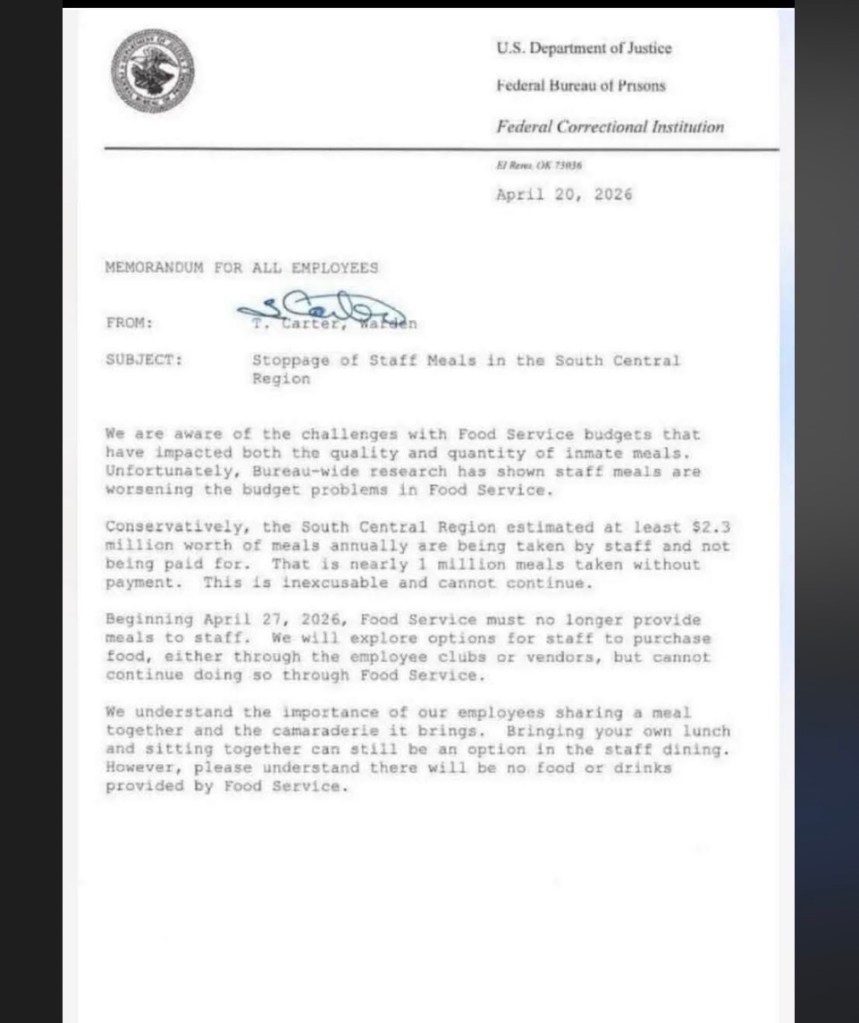
1. Summary of Concerns
The Loved Ones Coalition has identified concerns regarding the distribution of what appears to be an internal memorandum originating from the South Central Region.
The document, which references internal Food Service operations and budget-related adjustments, appears to have been circulated outside of official Bureau of Prisons channels. The manner in which this communication has reached external parties is unclear.
The presence of internal communications in public or external spaces raises concerns regarding information control, confidentiality, and the potential for misuse or misrepresentation of institutional information.
These concerns are particularly relevant in an environment where third parties may present themselves as having access, influence, or insider knowledge. The circulation of internal documents outside of official channels may contribute to confusion and create opportunities for misinformation or exploitation.
Taken together, the reporting raises questions regarding document control procedures, internal accountability, and safeguards surrounding the handling of institutional communications.
2. Key Allegation & Concern Table
| Allegation | Description | Potential Concern Area |
| Unauthorized distribution | Internal memorandum appearing outside official channels | Information Security / Oversight |
| Lack of document control | Unclear how communication was circulated externally | Administrative Oversight |
| Potential misuse of information | Risk of documents being used to misrepresent access or influence | Public Trust / Transparency |
| External dissemination risk | Internal communications reaching third parties | Institutional Integrity |
3. Systemic Concerns
The appearance of internal communications outside of official channels raises broader concerns regarding information control and institutional integrity.
Where internal documents are not adequately safeguarded, there is an increased risk that information may be used in ways that do not reflect its intended purpose. This may contribute to confusion among families and individuals seeking accurate information, particularly where third parties present themselves as having access or influence.
These concerns underscore the importance of clear protocols governing the distribution of internal communications, as well as accountability mechanisms when those protocols are not followed.
4. Oversight Questions for Clarification — South Central Region
- If this memorandum is intended as an internal communication, how did it come to be circulated outside of official Bureau channels?
- What safeguards are currently in place to prevent unauthorized distribution of internal documents?
- What accountability measures exist when internal communications are shared externally without authorization?
- How does the Bureau address situations where internal information may be used by third parties to misrepresent access or influence?
- What steps are being taken to ensure that internal communications are not used in ways that could contribute to confusion or exploitation of families seeking information?